Category Archives: Context & Narrative

My Learning Log for the Open College of the Arts’ course, Photography 1 – Context and Narrative

Constructed Realities: Rejected Ideas for Assignment 5

Each part of the course has thrown up ideas for this, final assignment; and each bit of course work has left something hanging, something that deserved a bit more attention than I was able to give it at the time:

Part 1 fed into thinking around the idea of just how ‘true’ a photograph isthat has been burbling along underneath all the other parts of the course; large chunks of my online tutorials have dealt with my increasingly conscious attempts to evade the indexicality (the direct correlation between thing photographed and the resulting image) of the photographic image. Also, this part of the course introduced the idea of constructing images rather than taking them. The idea of ‘truth’ became slipperier by the day…

Part 2 contained the revelatory idea (which I’d been circling round, without ever quite managing to sieze it ever since I first read The Ongoing Moment, some years ago now) that still photographs had more in common with poetry than with prose, when it came to the production of meaning. Narrative becomes more capable of alluding to things rather than telling a straight beginning-middle-end story.

Part 3 gave me the various sequences of diaristic photographs and allowed me to play with some of the ideas associated with conceptual art in the late sixties and early seventies as well as freeing up my inner surrealist a bit.

Part 4 allowed me to think about theory a bit and about the way that photographs produce meaning (or rather how viewers take the clues from within photographs and turn them into meanings) as well as reintroducing me to Cartier-Bresson and his contemporaries.


When my tutor suggested that I stage a street scene, constructing my own decisive moment rather than waiting for it to coalesce before me, my immediate reaction was to dismiss the idea out of hand. The amount of effort required – casting, storyboarding, taking the picture and on and on – was immense. And of course, I don’t have the time at the moment and I have set the clock ticking for getting C&N in for assessment by the end of April. And of course, somewhere there must be a bit of me that was horrified after absorbing all the tedious rules people set up around “street” – setting something up is cheating!

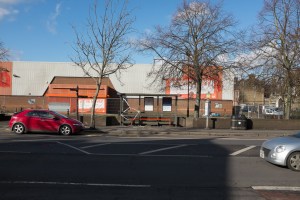
But then, soon after, I was walking home from Jubilee Park with Alice when I saw a great varied cluster of people at the bus stop outside the ex B&Q on the Lea Bridge Road. In a series of movements I got my camera out of my pocket, flipped open the ever-ready case (hah!) and brought my camera up to my eye just as a bus swished up and they all got on. Regardless, I still liked the shapes in the shot and took three pictures, stopping after a man positioned himself in the centre of the bus stop and started doing something with his phone.

Later,  when I got home and downloaded the pictures to my laptop, I realised that the framing was almost identical across the set and thought that maybe I could try collage-ing them into something by way of an exercise to try and answer some of my questions about seamless compositing and also to have a go at constructing a single moment from a number of indecisive ones.

Anyway, after about half an hour of messing around with layers, layer masks and the airbrush tool in Photoshop, I had welded the three pictures together, and could see where additional pictures could have been taken to add detail: something –  a cyclist heading right to left? a foregrounded pedestrian’s shoulder and the side of their head, waiting to cross the road? – in the bottom left corner of the picture, perhaps; maybe some more people at the bus stop.

Composite Picture

Even without the extra details, it isn’t bad I think, but for the assignment I think I’d want something a bit more planned, a bit more – well – meaningful somehow.

I had a better location for a constructed decisive moment, possibly one that referenced a picture roughly contemporary with the early work of Cartier-Bresson.
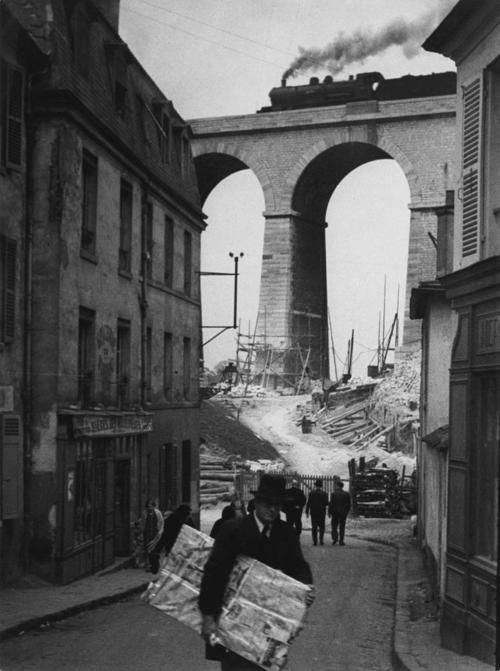
058/159-044 André Kertész Meudon, 1928 gelatin silver print 23.8 x 17.7 cm (9 3/8 x 6 15/16); 45.7 x 35.6 cm (18 x 14) Collection Soizic Audouard, Paris André Kertész photographs reproduced courtesy of the Estate of André Kertész and the Jeu de Paume/French Ministry for Culture and Communication

André Kertész Meudon, 1928

For the book that went with the TV series The Genius of Photography, Gerry Badger chose André Kertész’ 1928 picture Meudon as the first photograph he would look at in depth.

He writes (p.11): “This is clearly a ‘decisive moment’ picture, a particular instant in time when Kertész – probably looking for the train but also grateful for the man with the parcel – decided to press the shutter. […] But there could be another explanation behind the making of this photograph, Kertész may have known and posed the man with the parcel. […] We know that a day or two before making the picture Kertész made a ‘dry run’ or two. One of these shows the emptry scene, and in another there is the passing train.”

I have often thought about the possibilities offered by the view of Selborne Road in Walthamstow as you approach it down Vernon Road. Running across the back of likely frame there is a raised section of railway nd track as the overground approaches Walthamstow central. Trains pass every few minutes or so. People on foot and on bicycles and buses and cars, enter stage left pe stage right. And there on the right there is the spiral up to Sainsbury’s roof top carpark. I have never managed to  get all these elements to come together at a single time. Perhaps I could do this with a series of pictures, each one getting a single element right.

Simon Chirgwin Walthamstow 2017

Perhaps, I could also find someone to carry a picture across Vernon Road, between me and the junction…

But that would involve coordination, casting and waiting for a day when the southern sky wasn’t so bright, and the road so in the shade of the embankment that taking the pictures would be a technical battle against the contrasty light. I had another idea up my sleeve. One that would not involve anyone else. And one that would not involve leaving the house.


Reference:

Badger G. (2007) The Genius of Photography – How Photography Has Changed Our Lives 1st Edition. London. Quadrille


Influence as Context – Evans, Frank, Shore, Ohtake, Graham and me…

For further reading after assignment 1, my tutor suggested that  – among other things – I should read Tod Papageorge’s essay on the way Robert Frank had been influenced by his friendship Walker Evans and by Evans’ book American Photographs. The content of Papageorge’s essay did not directly appear to feed into the work I did in part two, but then, as part of the work leading up to Assignment 3, I kept a diary, which included sequences of everyday photographs taken as I wandered through my life, seeing things. While the most obvious influence on this work was Stephen Shore’s American Surfaces (I was working with a compact, portable camera, often using flash and generally the pictures were taken while I was on the move) the range of photographic reference points was not limited to Shore’s work. The photographs illustrating this post, I hope, demonstrate this. 


Continue reading

NFTU #2 – Tillmans at the Tate

To go along with his exhibition at Tate Modern, Wolfgang Tillmans was signing copies of the catalogue in the bookshop there this week. I’d already bought the book when I visited it soon after the opening, but I nipped out of work on the day of the signing and took my copy back to Tate. By the time I’d reached the front of the queue, I’d had enough time to think of something adequate to say about the exhibition so, as I stood in front of Tilmans (who is a tall man, even sitting down, I was able to say: “I enjoyed the exhibition; it made me think, and it made me think about my own photographs as well” which seemed a nice summary of where my head is at the moment and went down well with Tillman, himself.

I visited the exhibition at Tate Modern a couple of weeks ago, when it had just opened and was very impressed by the way that each of the rooms of the exhibition – described as installations – provided a shared context for the pictures displayed there; some of the pictures could have been displayed in different rooms from the one they were in, but then they would have gained some meanings and lost others. It was an interesting way to experience the show, heightened by the different sized pictures which forced you to step in and peer at one, and then to retreat across the room in order to be able to comprehend what the next was about.

The result was very different from Elton John’s collection of Modernist prints that is also showing across the bridge in the Switch House. There – in classic modernist style – they are hermetic, sealed, content to be just themselves. They’re beautiful, but they’ve been done and they cannot innocently be redone either.

They are – well – just photographs. They are lovely and it is great to see them, but they don’t make you want to somehow incorporate them into your own work or rather your way of working. Tillmans makes you (and helps you) construct your meaning from his rooms full of juxtapositions; the modernist pictures just are.


References:

  1. (2017) The Radical Eye – Modernist Photography from the Elton John Collection. London. Tate Moderm
  2. Tillmans, Wolfgang (2017) 2017. London; Tate Publishing

Constructed Realities – A digression into practical matters

5926082545_cc2a8a50d6_o

the view from the new home of the bbc world service – inkjet print, 400 cm x 110 cm simon chirgwin, 2011, unique

This was commissioned by the BBC Global News W1 Move project and stitched together from 7 medium format negatives. When printed very large indeed it looked cracking, but of course, when it came to moving out of Bush House, it was too big to fit in my car to take it home. It may still be tucked away in a cupboard somewhere in Broadcasting House.

As an edition of 1 (with no AP) it could be worth a fortune some day, but I suspect it ended up in a skip.


Continue reading

Constructed Realities: Project 2 – The Archive

c_n-05-exercises-4

On her website, Nikki Bird (Bird, 1) describes her project Question for Seller (2004-6, with the final auction of the pictures exhibited in Belfast and the compiled album in 2007) as follows:

Made from family photographs acquired through eBay, Question for Seller features photographs that no one else has bid for. The seller is asked the question: How did you come across the photos and what, if anything, do you know about them? Their replies are as important as the photographs they sell. They allude to disappearing histories, where personal photographs reveal fragments of past lives, through photographic processes that are themselves becoming obsolete.

On the page on the site about the album (Bird, 2) the pictures of spreads from it are accompanied by quoted replies (the answers to the questions to seller):

Continue reading

Constructed Realities: Project 1 – Crewdson, Beauty and Depth

Watch this YouTube video about Gregory Crewdson and his work and consider the questions below.

  1. Do you think there is more to this work than aesthetic beauty?
  2. Do you think Crewdson succeeds in making his work ‘psychological’? What does this mean?
  3. What is your main goal when making pictures? Do you think there’s anything wrong with making beauty your main goal? Why or why not?

C&N coursebook – p.116

1.

In the video Crewdson states straightforwardly: “First and foremost […] it’s to make a beautiful picture […] but a purely aesthetic experience is not good enough; that needs to be undercut by something psychological.” Later he goes on to identify “a darkness” that lies underneath his pictures and also to say “I want it all to become one world upon itself”. None of this necessarily will lead to something “more” than aesthetic beauty. Even assuming you find the pictures beautiful in the first place.

Continue reading

Constructed Realities: Project 1 – Setting The Scene; Exercise #1

Watch this famous scene from Goodfellas directed by Martin Scorsese in 1990:

http://www.youtube.com/watch?v=OJEEVtqXdK8  %5Baccessed 24/02/14]

Don’t read on until you’ve answered the following questions.

  • What does this scene tell you about the main character?
  • How does it do this? List the ‘clues’.

C&N Coursebook p. 109

The long tracking shot tells you that Henry Hill (Ray Liotta) knows the club well – he does this a lot –  and the staff there treat him with warmly and with respect. He is in favour there. Continue reading

Assignment 04 – A Picture Is Worth A Thousand Words

A version of this post revised in April 2017 is available here.


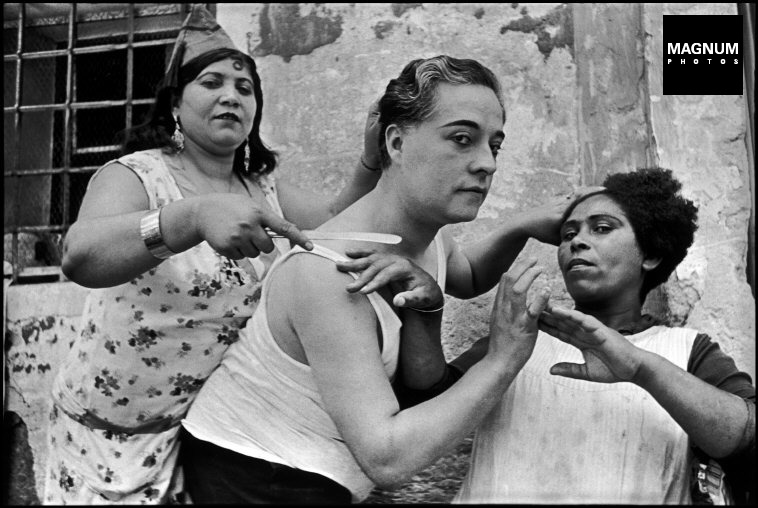
Three women, frozen in time, are looking out at me, doing… something.

SPAIN. Valencia Province. Alicante. 1933.

fig 1. Henri Cartier-Bresson; Spain –  Valencia Province. Alicante. 1933.

Each woman touches one of the others.  On the left –  wearing a pointy hat and a floral-patterned dress – a Mexican-looking woman has one hand on the back of the head of the woman next to her while her other hand stretches around her right shoulder holding – bang in the middle of the picture – a straight razor. On the right, a dark skinned – African? – woman leans back. Her hair is pushed from her temple by the central figure’s left hand. She raises her left hand defensively towards her face; its palm could be either warding off a blow or trying to block the camera’s view. The fingertips of her other hand brush delicately over the strap of the slip – or is it a man’s vest? – crossing the central woman’s right shoulder. This figure leans in towards us wearing a marvelously neutral expression, emphasised in the composition by the light patch of out-of-focus plaster behind her and her head’s size within the frame.

I looked again and paused. Is the woman in the middle a man?  Her clothes are hard to read – is that a man’s vest? – the angle and the tangled arms mean you cannot see whether  she has breasts. Her face is quite masculine, and her eyebrows, while shaped, are thick. But the arms and face are hairless, too – the razor? or is it a woman being dressed up as a man?

My first thought had been of Matisse’s dancers, but his maidens dance in a ring, lost in their rite, unaware of being watched. These three are – regardless of gender – not maidens and make eye-contact with me through the lens of the camera, across time. Then, my mind glanced away to another Spanish scene and another razor, slicing across an eyeball at the start of the film, Un Chien Andalou (Buñuel & Dali) but it wasn’t  the razor that kept me looking.  I felt uncomfortable having been spotted; caught looking at something I am not supposed to see; I am in a place where I am not supposed to be…

But of course, where I really am is standing in front of a black and white, sixteen by twelve inch, gelatin-silver print, placed by its label in space and time. Alicante, Valencia Province, Spain 1933 hangs on the wall of the Fine Art Society, part of an exhibition (Cartier-Bresson, 2016) of fifty prints made under the supervision of the photographer, Henri Cartier-Bresson, for an American collector, in the 1990s.

Later, I find out more about the picture (Cartier-Bresson, 1933a). It was taken before Cartier-Bresson became a defining figure of photojournalism, differentiating his work through the idea of “The Decisive Moment”. At this time he was simply the dilettante son of a prosperous French family, travelling with his revolutionary (and expensive) Leica camera, finding out what he could do with it.

Cartier-Bresson had spent time in Paris, studying painting and hanging out in his spare time with the Surrealists (Chéroux, pp.15-18). From the former he had absorbed rigorous ideas about geometry in composition and from Surrealism the idea that the intrusion of the random (something in the wrong environment; the subconscious bubbling up into dreams; an everyday object treated with surprising veneration) could transform reality into something considerably more charged.

FRANCE. Paris. Place de l'Europe. Gare Saint Lazare. 1932.

fig 2: Place de l’Europe. Gare Saint Lazare.

The previous year, Cartier-Bresson had already created at least one of the images defining The Decisive Moment (fig. 2: Cartier-Bresson, 1932), but this picture is quite different.  It will not be included in the book (Cartier-Bresson, 1952) which established the concept in the public mind. The background has not been chosen to be brought alive by the intrusion of chance action; the camera is not static, but instead tracks with (while not quite containing) the lurching movement of the three figures from left to right. And there is obvious collusion between the photographer and the subjects. Indeed, there is even another photograph of two of them in front of the same wall, available on Magnum’s website.

And there is obvious collusion between the photographer and the subjects. Indeed, there is even another taken of two of them in front of the same wall, available on Magnum’s website.

SPAIN. Valencia Province. Alicante. 1933.

fig 3: Valencia Province. Alicante.

This second picture (fig. 3: Cartier-Bresson, 1933b) lends support to the idea that the central figure is male (vest? – yes – and trousers), the keywords associated on Magnum’s site with both  – “Man – 25 to 45 years“; “Woman – 25 to 45 years“; “Homosexual“; “Prostitute” seem to deliver a definitive judgement. “Mischievousness” – another keyword – further suggests the spirit in which Cartier-Bresson and his accomplices set about making the picture.

But, having to some extent cleared up its mysteries, I was still left with something more than a picture recording some fun had by Cartier-Bresson with people he’d stumbled across while – like Brassaï and others in Paris at the same time – combing the seamier side of Alicante. The question remained of why it still held me.

I’m looking up from below the women’s eyeline and three pairs of eyes stare down at me; all three expressions are flat, knowing, yet unreadable. In Rhetoric of the Image, Barthes (1964 p.44) had already highlighted the disjunction between the present (pictured in a photograph) which has passed by the time it is looked at. Then, in the second part of Camera Lucida, Barthes  (1981 pp 111-113) considers whether a direct address to the camera can fulfill the role of punctum – a subjective link with something in a particular photograph  – creating a link across years, between a picture’s subject and the viewer across years. He concludes yes and I agree; it is here that the power of this image lies.

Whether or not the three people caught by Cartier-Bresson survived Valencia’s fall at the end of the Spanish Civil War (and transvestites and prostitutes wouldn’t have had an easy time under Franco) they would all be dead by now, eighty-four years later. I will never know who they were or exactly what it was that they were acting out, but I do still wonder.

And now Cartier-Bresson is also dead and the prints in the exhibition are all for sale, none for less than eight thousand pounds. If I had the money, it is the picture I would buy from the exhibition. I like it a lot. But it would not hang in my living room acting as a token of value and of my good taste. That would cauterise its mystery. Rather, I would tuck it away around a corner – on the way to the bathroom, perhaps – where visitors, like the viewer inferred by the picture, could stumble across this ambivalent scene, stare a moment and wonder what it was that they had just seen and just why it left them feeling somehow unsettled…

(1081 Words)


References:

  1. Barthes, R (1964) Rhetoric of the Image In: Barthes, trans Heath (1977) Image Music Text London. Fontana. pp 32-51
  2. Barthes, R , trans Howard (1981) Camera Lucida London. Vintage
  3. Buñuel, L and Dali, S (1929) Un Chien Andalou France
  4. Cartier-Bresson, H (1932) FRANCE. Paris. Place de l’Europe. Gare Saint Lazare. [silver-gelatin print] [online image] Available from: https://pro.magnumphotos.com/Asset/2S5RYDI9CNRQ.html (accessed 13 January 2017)
  5. Cartier-Bresson, H (1933a) SPAIN. Valencia Province. Alicante. [silver-gelatin print] [online image] Available from: http://pro.magnumphotos.com/Asset/-2S5RYDWDPDPD.html (accessed 10 January 2017)
  6. Cartier-Bresson, H (1933b) SPAIN. Valencia Province. Alicante [silver-gelatin print] [online image] Available from: http://pro.magnumphotos.com/Asset/-2S5RYDGY9XV.html (accessed 10 January 2017)
  7. Cartier-Bresson, Henri (1952)  Images à la Sauvette Paris. Verve, (also published in English as The decisive moment New York, Simon and Shuster)
  8. Cartier-Bresson, Henri (2016) Decisive moments. London; The Fine Art Society
  9. Chéroux, Clément (2008) Henri Cartier-Bresson – New Horizons. London. Thames & Hudson

NFTU # 1 – Joel Sternberg

Joel Sternberg: “A photograph is only a fragment of a shattered pot” (O’Hagan,2017, p.18)

Joel Sternberg: “You take 35 out of 360 degrees and call it a photo” (O’Hagan,2017, p.17)

So, am I taking (finding?) a series of shards that I hope will turn out to be a complete pot one day?


Reference:

O’Hagan, A (2017) The drifter. The Guardian (G2). 11th January. p.16