Category Archives: The Art Of Photography

My Learning Log for the Level 4 Open College of the Arts’ course, Photography 1 – The Art of Photography

sunday on the marshes

Walthamstow - Shutter Speed and Motion

Nikkor 35mm f2 AF-D; 1/60th; f22. ISO 200.

A good, productive morning, taking the pictures for the last two Getting To Know Your Camera Exercises (the movement ones) and also managing to get raw material for the first two of the Framing Exercises.

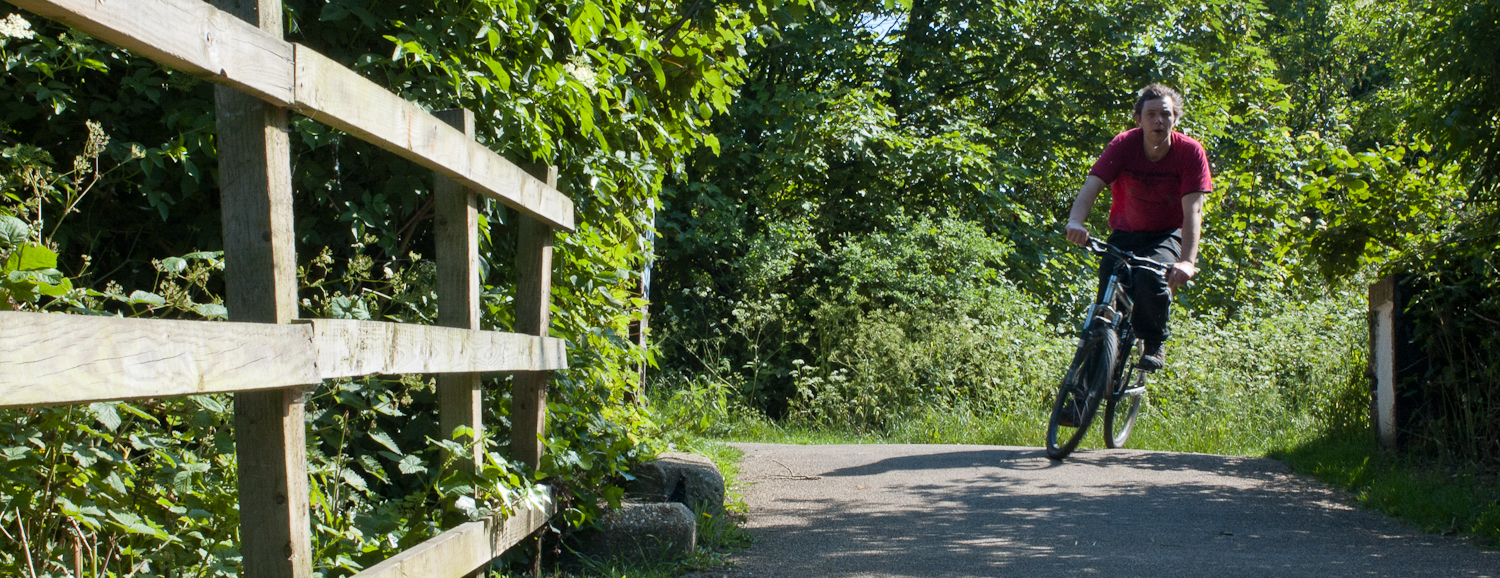
I headed down to the Lea Valley Marshes and spent the best part of an hour with my D50 on a tripod, focussed on a t-junction where there was likely to be a fairly steady stream of cyclist, joggers and people walking dogs, working through shutter speed and aperture combinations, and then crossed the river into Clapton, sat on a bench set a little back from the navigation’s tow path and panned with cyclists as they went past.

For the second framing exercise (Objects in Different Positions in the Frame) I took advantage of the numerous flight paths that cross the Lea Valley and the cloudless blue of the sky to take pictures of planes as they went overhead. Startlingly difficult, using a long lens (the full extent of my longest zoom is 300mm) to keep it all steady, shoot, reframe and not lose the (auto)focus. I think I have the pictures I need, but took way too many…

Then, on the way home, for the first of the framing exercises (Fitting the Frame to the Subject) I noticed a unit (?) a stockade (?) – it certainly isn’t a shop or a garage –  selling tyres, with a fair amount of signage outside, and decided to try a sequence of pictures of it, rather than go out again later and use a nice, orange and west-facing (so not lit yet) corner shop as the subject of the exercise.

I’ll write up each exercise separately, once I’ve edited the pictures for them…

So, a lot of ground broken, but plenty to do in terms of analysis and writing everything up. Two immediate thoughts on the days shooting: the first ties into the ethical question of whether its ok to take pictures of people in public spaces  the other regarding my rather tired digital camera. Both of them are covered in other posts, here and here

how normal is normal anyway, pythagoras?

One  footnote to the first of the introductory exercises is that I finally did the sums to work out the “normal” focal length for both a frame of 35mm film and for my smaller DSLR sensor and was slightly surprised to discover that:

DSLR: 23.7 squared + 15.6 squared = 805.05 or 28.4 squared: – ie the diagonal = 28.4mm

Film: 36 squared + 24 squared  = 1872 or 43 squared – ie the diagonal = 43mm

So, rather than being normal, a 50mm lens is ever so slightly telephoto and the nearest I can get to a normal angle of view with a prime lens on a film camera is my Olympus Trip 35 with its 40mm fixed lens. And on my DSLR I need a 28mm lens rather than the 35mm one I’ve blithely been using for ages now.

So there…


getting to know your camera # 1 – focal length and angle of view

A straightforward exercise and something I’m surprised I’ve never actually done before. For it I used my Nikon D50 body, Nikkor AF-D 35-70mm f2.8 zoom at both ends of its range and a Zenitar 16mm f2.8 to give a final, wider version of the view. I was interested to see that – when looking through the viewfinder with the other eye open – sizes didn’t match at a focal length of 35mm (the normal/50mm equivalent for my camera’s sensor) but did when the lens was zoomed in to about 50mm. While the angle of view was correct for the 35/50 equivalency, optically the perceived size was correct only with a tighter focal length. Presumably this means that my “sensor size” (the retina of my eye) is closer to the frame size of 35mm film and while it is seeing a narrower angle through the viewfinder (approximating to a 75mm lens on a film camera) the visible size of the objects seen remains the same. Certainly, a couple of days later, trying a 50mm lens on a film SLR, it was still the 50mm lens that gave the same perceived size in both eyes. Now, it would be worth trying this with a medium format SLR and a 50mm lens, just to check whether a 50mm lens – acting as a wide-angle this time – would show objects the same size in the viewfinder as they appear through the other eye in reality.

Anyway, here is a composite of the three shots I took, with the tighter angled pictures scaled down to the equivalent size in the widest and then pasted over the original with the frame’s edges outlined:

Image

When I returned with 3 A4 printouts, I was just able to get my hands far enough away from my face for the 70mm picture to match the size of the original, the 35mm picture was ‘right’ with a slightly obtuse angling of my elbows and the 16mm picture would have needed to be too close to my face for me to focus.

Of course, I forgot to take a tape measure with me, but – back home with a ruler and relying on muscle memory, or whatever it’s called – I was able to estimate the distance at which the prints matched up in size to the view as being 70cm for the tightest and 35cm for the middle one. The widest was impossible to gauge, but it seemed to be almost right when the paper was around 10cm from my face; from the other two, it presumably would have been about 16cm given that (for an A4 print) focal length in mm equals arm’s length in cm…

Hello World!

Getting Started and Setting up my Workspace. Things to do:

  • Start Learning Blog (Done)
  • Profile Picture – choose, edit and upload (Place Holder in Place – 25-iv-14)
  • “About me” blurb (Done – 29-iv-14).
  • Schedule (detail for Part 1 of course; high level for rest; remember to include time off!)