Author Archives: Simon Chirgwin

NFTU #3 – Nikki Bird + Beneath the Surface

bidston-2-colour-edit

Scapa Court, Kirkwall (KW15 1BJ) in 1968/69 and in 2016

‘[Showing] the relationship between the past and the present […] so it’s not just “the past is over here and the present is over here” and that is it’

– Nicky Bird, interviewed on video for the Stills Centre of Photography in Edinburgh

While I was doing some reading on Nikki Bird for part 5 of C&N (around Question for Seller), I came across a later piece called Beneath the Surface, where Bird had worked with people whose part of Scotland had been “wiped away” to combine their photographs with up to date pictures of the places in the pictures. At the time when she first started thinking about this, she had been involved with an archaeological dig in Edinburgh.

Bugger! I thought. Continue reading

The Masks I Construct – Social Media Profile Pictures

reichstag ceiling – used as my cover photo on facebook

‘If you have a social media profile picture, write a paragraph describing the ‘you’ it portrays. What aspects of yourself remain hidden?”

IaP Coursebook p.13

I have several social media profile pictures, using different ones for different sites, representing a different avatar of mine.

‘I’m using “avatar” not in the Hindu sense of embodied deities, but in the modern sense of online creatures who stand for, or in front of, aspects of real life.’

Jackie Ashley, The Guardian, 17/02/17

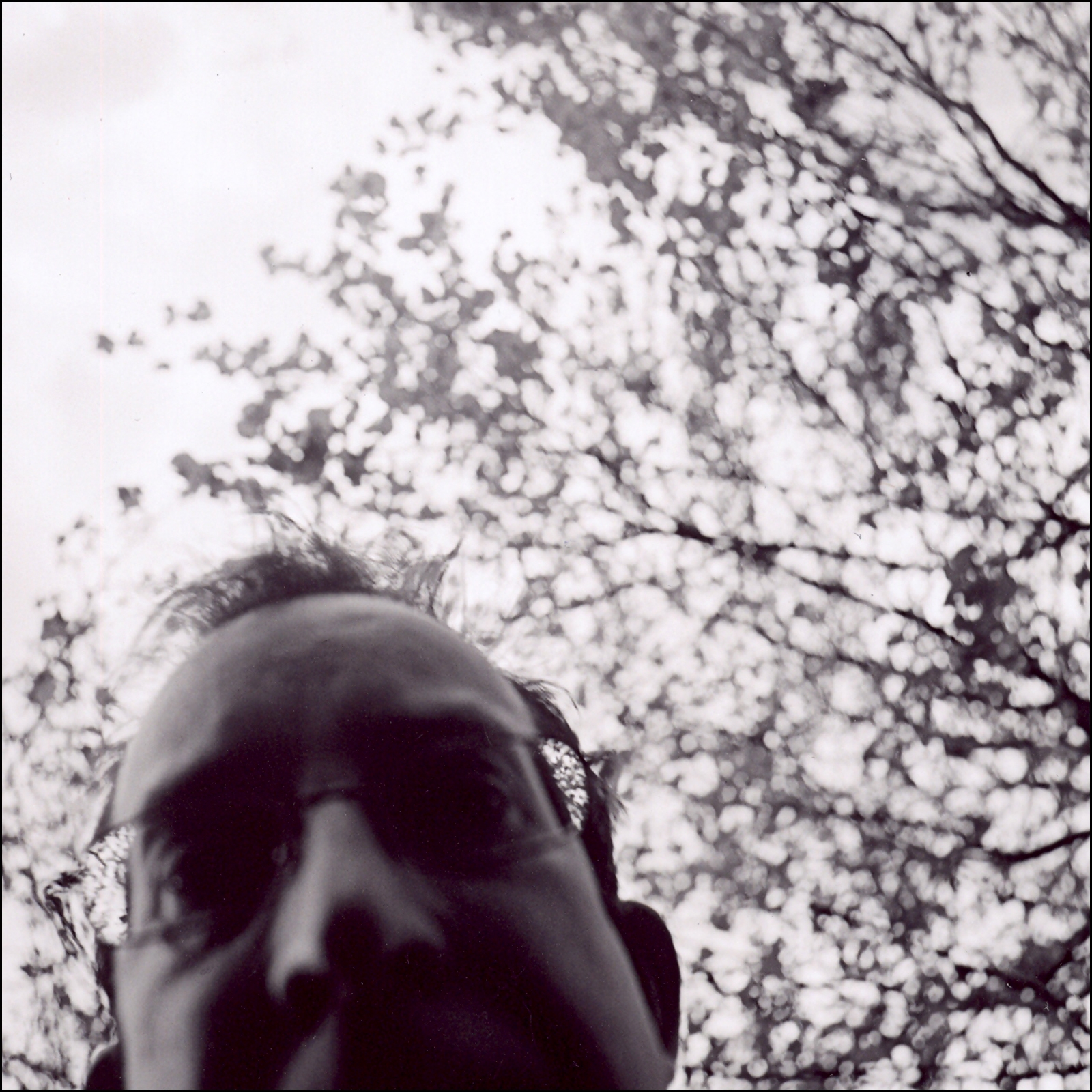
hang on - is that what's the matter? ah! whirr-kerrr-chunkh! (inadvertant self-portrait # 352)This is the one I use (cut down slightly) on Flickr:


 I use this one on Twitter:
avatar_400x400


…and this, on Facebook:

Continue reading

Putting Yourself in the Picture: Project # 3 – Self-Absented Portraiture

after shafran – chirgwin, 2017

“Go to the artist’s website and look at the other images in Shafran’s series. You may have noticed that Washing-up is the only piece of work in Part Three created by a man. It is also the only one with no human figures in it, although family members are referred to in the captions.

Coursebook (p.87)

1: Did it surprise you that this was taken by a man? Why?

While I cannot think of any male photographer’s whose work includes large chunks of the sort of scrutiny of their (naked) self that you find in Woodman’s work, or who would document the way going through IVF-treatment with their partner (or even just ” trying for a baby”) effects them in the way Brotherus does, there are plenty of women who take pictures of mundane details from their lives. Indeed, there is a strand of this running through Brotherus’ Annonciation.

So, I wasn’t at all surprised that Shafran’s washing up pictures were taken by a man, but I wouldn’t have been surprised if it had been taken by a woman either. Continue reading

Putting Yourself in the Picture: Project # 1 – Autobiographical Self-Portrait

I’ve just noticed that this post’s trigger from the coursebook says “Make some notes”. This is more like an essay. Or a short book.

The first time this post was saved was on – good grief! – the 28th of June 2015. I have written a bit, gone off to do an exercise, come back, written some more, gone away and done the assignment, put off writing up the other exercises and now come back here again, after I have completed all the write ups for part five and begin to prepare the module for assessment.

And so, for the umpteenth time, I realise that I really must start working in a way that produces shorter, more notey, blogposts…

Simon Chirgwin, April 2017


And now here is what I started writing last June; I have changed hardly anything; I cannot understand why I didn’t just hit “publish”… Continue reading

Assignment 4 – Tutor’s Response

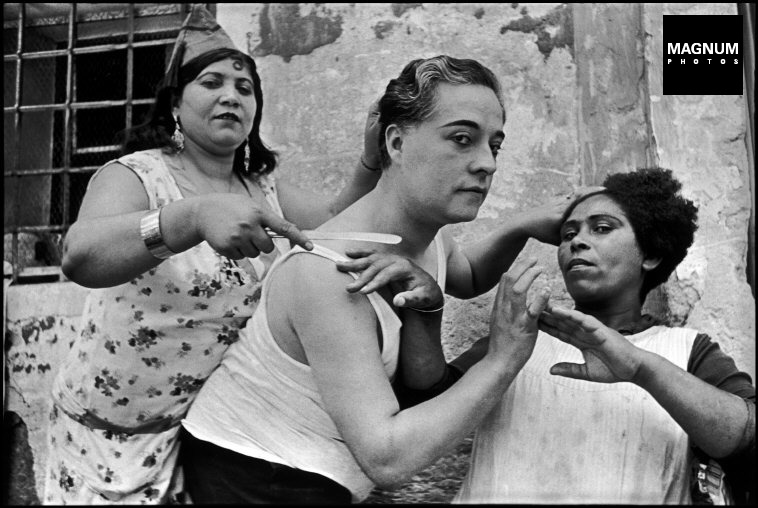
“Really well written descriptions and then interpretation of Cartier Bresson’s Alicante, Valencia Spain, 1933. The contextualisation with reference to surrealism […] is well formed […] the exploration of form and content which gives rise to these contextual meanings is well researched,  looking at gesture, formal signs as well as the ambiguity (gender) of the subject and the way the ‘returned gaze’ questions these assumptions […] is well grounded […] This is a quite comprehensive review and a nice discursive style (yet still retaining a critical analysis).”

– Formative Feedback to Assignment 4, Garry Clarkson, OCA Tutor

Garry’s feedback – both during another marathon google hangout and in its distilled written-down form – to my short essay on Cartier-Bresson’s photograph taken in Valencia in 1933 was gratifyingly positive. Continue reading

Assignment 4 – Revised After Feedback from my Tutor

Three women, frozen in time, are looking out at me, doing… something.

SPAIN. Valencia Province. Alicante. 1933.

fig 1. Henri Cartier-Bresson; Spain –  Valencia Province. Alicante. 1933.

Each woman touches one of the others.  On the left –  wearing a pointy hat and a floral-patterned dress – a Mexican-looking woman has one hand on the back of the head of the woman next to her while her other hand stretches around her right shoulder holding – bang in the middle of the picture – a straight razor. On the right, a dark skinned – African? – woman leans back. Her hair is pushed from her temple by the central figure’s left hand. She raises her left hand defensively towards her face; its palm is either warding off a blow or trying to block the camera’s view. The fingertips of her other hand brush delicately over the strap of the slip crossing the central woman’s right shoulder. This figure leans in towards us wearing a marvellously neutral expression, emphasised by the light patch of out-of-focus plaster behind her and her head’s size within the frame.

I looked again and paused. Is the woman in the middle a man?  Her clothes are hard to read – is that slip actually a man’s vest? – the angle and the tangled arms mean you cannot see whether  she has breasts. Her face is quite masculine, and her eyebrows, while shaped, are thick. But the arms and face are hairless, too – the razor? Is it a woman being dressed up as a man? Continue reading

Assignment 5 – Reflection

scan of a print proof, made during my development of the final picture (post-poem, pre-guardian dimensions)

1: Demonstration of technical and visual skills

Described simply, the work for this assignment takes two things – a picture based on a French advertisement and one of TFL’s poems on the underground – and combines them into a single whole, capable of multiple readings. I think the picture hangs together conceptually and aesthetically,  creating an image that is good to look at. Continue reading

Assignment 5 – Making it up

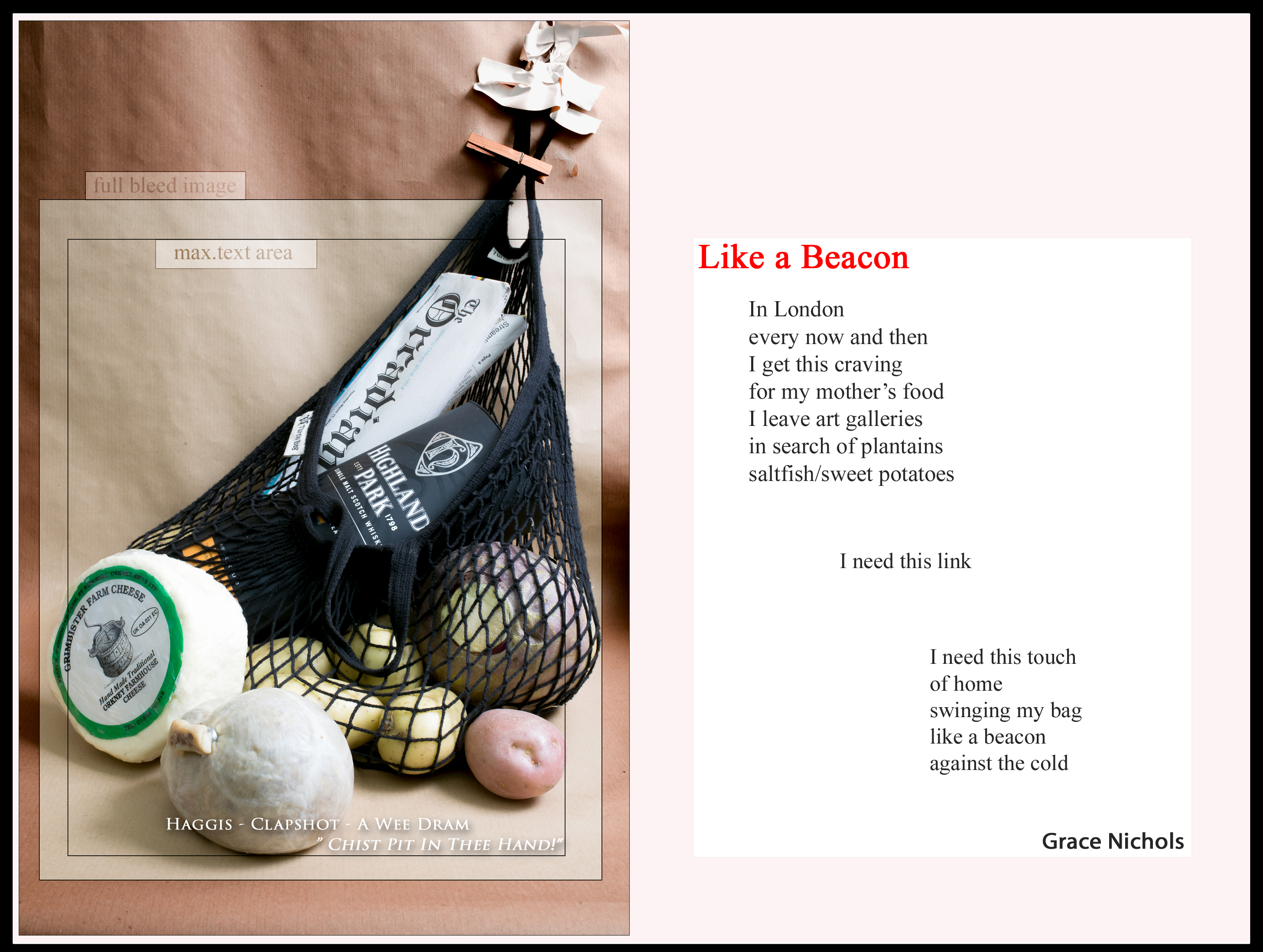
                                                                                                                             Orcadianicity Simon Chirgwin 2017


Three things feed into this image:

  1. Firstly, there is the poem itself (Like a Beacon, by Grace Nichols) which I first encountered as a Poem on the Underground on my way to work a little over a year ago
  2. Then there is Roland Barthes’ 1961 essay, Rhetoric of the Image which deals with the way an advertising photograph for Italian food products intentionally creates its meaning for a specific target audience.
  3. And finally, there is me.  Like Nichols I grew up on an island and now live in London; like Nichols, I haunt art galleries; and like Nichols, I sometimes long for a taste of foods that i grew up eating…

This third thing is what pierced me, drawing me to the poem. This is one of things i am trying to say with this picture. I think I am attempting to transfer a Barthesian punctum – or the literary equivalent of one – from one medium – a poem – to another – a photograph.

Of course, I am not a poet. I am a white European man, not a West Indian woman. My mother did not give me whisky with my tea and haggis is not particularly Orcadian. But I do like to eat it and clapshot is definitely Orcadian (and tasty too, if you add plenty of butter and pepper). Continue reading

Assignment 5 – The Idea

Construct a stand-alone image of your choice. Alternatively, you may choose to make a series, elaborating on the same theme […] The only stipulation is that you produce work that has been controlled and directed by you for a specific purpose. Remember to create a story with a specific context like the artists you’ve looked at in Part Five. This means you need to have an artistic intention, so a good place to start would be to write down some ideas.

– Context and Narrative Course Book (p. 122)

During part two, I wrote this in my post on using a poem (Like a Beacon by Grace Nichols) as the basis for a photograph:

“A constructed picture. A still life, along the lines of the” [Barthes/Panzani] “pasta ad!”

I even went so far as to make up a shopping list and reckoned that I might have made the resulting still life some time in March.

That was, of course, in March 2016… Continue reading