Author Archives: Simon Chirgwin

Exercise 1:4 – Archival Intervention

the cover of a photo album put together by my father sometime in the early 1950s

‘Look through your own family archive and try to discover a series of portraits (four or five) that have existed within this archive, but have never been placed together before. The portraits can contain individuals or even couples; they may span generations, or just be of the same person throughout the years (chronotype). Whichever way you wish to tackle this exercise, there must be a reason or justification for your choices. What message are you trying to get across about these portraits?’
– IaP Coursebook, p.34

I think this set of five pictures (plus one extra, acting as a full stop) tells a fairly straightforward story – a man is born, grows up and gets married, has a family and then dies – without much need for explanation. But I shall provide short captions anyway to try and make this story a bit more complex, because it is about other things too, including history and class and society and place. And, of course, because the man is my father, me.

Continue reading

Exercise 1.3 – Off to one side a bit


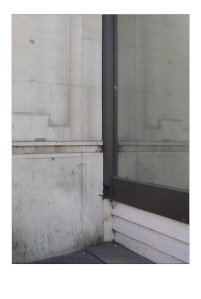
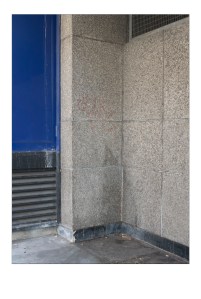
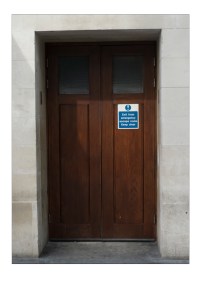
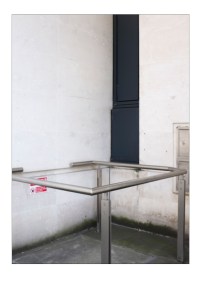
places where people who were smoking outside buildings had been smoking – april 2017


As mentioned in my previous post, easily as many people declined to have their picture taken by me as agreed to be included in my smokers’ typology. After a while, I realised that I could always take a picture of where some of them had been standing, after they had gone. I tried to keep the focus slightly in front of the wall, where the smoker would have been and tried to make interesting compositions that would work with the others in a grid.

Here they are. I quite like the effect and probably would be more likely to have these printed, framed and hung on a wall somewhere than the ones that actually have people in them.

Exercise 1.3: A Typology of My Own

‘In response to Sander’s work, try to create a photographic portraiture typology which attempts to bring together a collection of types. Think carefully about how you wish to classify these images; don’t make the series too literal and obvious.’

– IaP Coursebook p.29

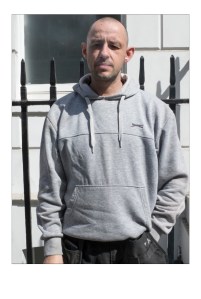
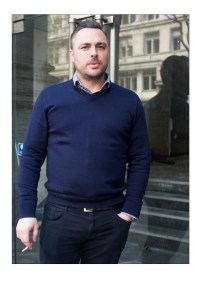
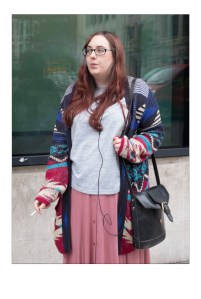
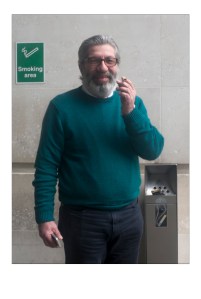
people smoking outside buildings – central london, april 2017


“Excuse me – for an art college project, I’m taking photographs of people smoking outside buildings; you’re smoking outside a building – can I take your photograph, please?

I said this, or some version of this more than a hundred times over the course of six or so lunchtimes back in April. Around forty people said yes and I ended up with around seventy-five pictures (usually two of each smoker: one of them with a cigarette near or in their mouth; the other with the cigarette well out of the way of their face) that I was happy enough with for them to go through to the next stage of the edit. Continue reading

Exercise 1.2: Background as Context

sean in the three judges, glasgow – may ’17

“Make a portrait of someone you know, paying very close attention to what is happening in the background of the shot. Be very particular about how you pose the subject and what you choose to include in the photograph. Ideally, the background should tell the viewer something about the subject being photographed.”
IaP Coursebook, p.26

I have mentioned Sean in my learning log twice before: he was one of the people who helped me generate my self-portrait in part three of  Context and Narrative and he made a cameo appearance as a ‘colleague’ in my discussion of Robert Adams’ Why People Photograph during The Art of Photography.

We both come from Orkney; our sons are in the same class at school; we shared a flat for a while. I have played in bands with him, played in the same Glasgow chess club. He is a rather good photographer and writes proper computer code for a living.  Continue reading

August Sander and Typology

‘What did August Sander (1876-1964) tell his sitters before he took their pictures? And how did he say it so they all believed him in the same way? […] Did he simply say that  their photographs were going to be a recorded part of history? And did he refer to history in such a way that their vanity  and shyness dropped away, so that they looked into the lens , telling themselves, using a strange historical sense, “I looked like this”?’

– John Berger (1979)


The more I look at August Sander’s photographs of people in Germany at the start of the 20th century, the less certain I become of what exactly it is that I’m meant to be looking at. If – as Sander claimed – they form a cross-section of a society, it is not a society that I have personally experienced. 

All my examples are taken from the 1994 reissue of Face of Our Time. Sander died in April 1964, a month after I was born; time has moved on and if I wish to pick up on signifiers that would have been shared by Germans of Sander’s generation, Looking at his pictures, I must act as a historical detective, not as a member of that ‘Our’ in the title.

Continue reading

Exercise 1.1: Jean-Baptiste Frénet – Madame Frénet et fillettes, c.1855.

Madame Frénet et fillettes, c.1855. (Image Copyright, Wilson Centre for Photography)

I went twice to see Tate Britain’s 2015 exhibition Salt and Silver. This picture hung in the final room, Portraits and Presence. Certainly, it was the presence of a woman who must have been dead for nearly a century and a half by the time I was standing in front of her portrait that drew me back to this particular photograph again and again.
Continue reading

Glossary – Collodion Process

After its simultaneous discovery by Frederick Scott Archer and Gustave le Gray in 1851, the collodion process for producing wet-plate negatives quickly superseded the earlier Daguerrotype and Calotype methods for capturing images. Glass Collodion negatives were more sensitive to light (meaning that they required shorter exposures) than either of the older processes and were capable of finer detail than the grainy paper negatives that were used for Calotypes. Continue reading

Simon Chirgwin (512973) Context and Narrative – Notes for Assessors

Hello Assessors!

Nested below the link to Context and Narrative  (at the top of the page, under the title bar; it will take you back here, if you click it) there are 3 sub-category menus, each with further nested links to allow you to view specific categories of posts. I have replicated this tree of links here:


Assignments


Coursework


Research and Reflection


Each of the Assignment categories is headed with a brief introductory post, containing links to the Tutor’s Report and details of both files included in the physical submission and stored on the OCA g:drive folder that has been shared with me for this purpose.

I have not been able to reverse the most-recent-to-oldest sorting of the posts within any of the sections, or indeed in the blog as a whole, but assume this is normal.


The physical submission for this Module includes a full index. The online files to accompany the assignments follow a simple naming convention:
The common prefix: PH1CAN-512973-Assessment; the assignment number: 1-5; and the individual file number for that assignment.
So, PH1CAN-512973-Assessment-3.01 is file number one for assignment 3 and PH1CAN-512973-Assessment-2.02 is the second file for assigment two.

And thank you for your time, reading all this.

Assignment 5; Making It Up – Notes For The Assessors

I have included a print of the original picture for this assignment in the physical submission for this assessment. There is also a high resolution picture file in the assessment event G-Drive folder called PH1CAN-512973-Assessment-5.1.jpg

During the online tutorial for assignment 5, Garry and I discussed remaking the still life that forms the heart of the single picture I produced. This remake would have a different background and the lighting would be further refined to improve the definition of the left side of the objects contained in the shopping bag.

Because of the difficulty of getting hold of some of the ingredients in the picture – the cheese in particular – I have not yet been able to do this, but will definitely give it a go after my holiday “back home” in Orkney later in the summer.

Tutor’s Report – Assignment 5

All related posts can be found either here or by using the link in the main menu at the top of this page.

Assignment 4; A Picture is Worth a Thousand Words – Notes For The Assessors

Following the tutorial for this, I rewrote  my essay to include more of a context for the way that Cartier-Bresson’s reputation has developed and changed since the 1950s. I then spent a lot more time getting it back down to under 1000 words + 10%!

This is version uploaded to the assessment g:drive (and also available here as part of my online log). In the g:drive copy, I have bold-ed the two paragraphs containing significant changes from the original.

On the g:drive, the file is called 512973-PH1CAN-assignment4-revised

Tutor’s Report – Assignment 4

All related posts can be found either here or by using the link in the main menu at the top of this page.