Category Archives: Identity & Place

Course 3 of the OCA BA in Photography

exercise 2.3 – same model, different background

‘Consider the work of both Callahan and Germain, then select a subject for a series of five portraits, varying the locations and backgrounds. The one consistent picture element must be the subject you have chosen, who must appear in all five images. Think carefully about where you choose to photograph them, either using a pose that offers a returned gaze to the camera, or simply captures them going about their daily business. The objective once again is to visually link the images together in some way.

Present your five images as a series and write around 500 words reflecting on the decisions
you made. Include both of these in your learning log or blog.’

– IaP Coursebook p.51

My son, James is nearly fifteen, on the cusp of being an adult. He lives with his mother in Glasgow, while I live in London, but I do manage to get up once a month or so and see James. Every year we go on holiday to Orkney, where I grew up.

This year we managed to make a couple of day trips to some of the smaller islands that fringe Scapa Flow. For this exercise I’ve put together a series of pictures to make a single day from various days of outings.  Continue reading

Project 2.1: The Unaware – Evans, Kuzma and Parr in the Underground

While I was doing the research for this project, I made a trip to Kyiv for work. All the photographs illustrating this post were made during this trip, on the city’s soviet-era metro system. I have known about these pictures for a long time now – indeed one of my clearest memories of the 2010 exhibition Exposed at Tate Modern was standing in front of the glass case containing the blackened Contax Rangefinder hidden beneath his coat by Evans to take his subway pictures –  and have often taken photographs of my fellow travellers on public transport wherever I find myself.

fig.1 – on the Kyiv Metro

I have written about Evans’ subway shots before so – as this course is concerned with identity as well as location – will only add a couple of brief notes here. Continue reading

exercise 2.2 – the unaware

Closely consider the work of the practitioners discussed above [Walker Evans, Lukas Kuzma, Martin Parr, discussed here, and James Wood who I feel fits better in with section 3] then try to shoot a series of five portraits of subjects who are unaware of the fact they are being photographed. The reflection about your methodology will be as important as the final five images, so be prepared to write about how you found the experience (around 500 words) and present your findings via your learning log or blog.

 – IaP Coursebook, p.47

For the exercise on reportage in Context and Narrative, I took two series of quite traditional street photographs. Now I wanted something less Gary Winogrand and more Phillip-Lorca diCorcia; something pulled back, something more truly covert.

fig.1 – untitled

I like Walker Evans’ subway pictures, but this time, I took as my starting place a different set of pictures by him – the eleven anonymous portraits of workers leaving a factory in Detroit, published in Fortune magazine in 1946 as ‘Labor Anonymous’.

The 150 pictures taken for that assignment caught their subject moving obliquely across Evans’ field of view from right to left. The camera Evan’s used was held at waist height and the pictures were cropped down into a regular composition before they were published. Continue reading

exercise 2.1 – individual spaces

‘Make three different portraits using three different subjects. Prior to shooting your portraits, engage with your subjects and agree three different specific locations which have some relevance or significance to them individually. This can either be inside or on location, but the key to this portrait is the interaction you’ve had with your subject in identifying a place that has specific meaning for them. Each portrait should be accompanied by a very short piece of text explaining the choice of location or venue. Don’t be tempted to create a work of complete fiction here; it might make life easier for you, but you’d be missing an opportunity to really engage with your subject and collaborate with them in the image-making process’

–  IaP Coursebook – p.40

All three of the people pictured for this exercise live in Kirkwall, Orkney and the pictures were taken during my annual trip north in August 2017. I am related to all three of them, so, to a certain extent, I was able to grasp the reasons why they had chosen the locations they had fairly quickly. None of their reasons seemed odd to me; all of them had chosen places with links to their respective childhood. Interestingly – like the places I’d chosen to represent my square mile – none of the locations turned out to be quite the same as the place that existed in my subject’s memory. Continue reading

assignment 1: the non-familiar – reflection + tutorial feedback

nearing the end of the edit for my typology

1: Demonstration of technical and visual skills

During the video tutorial for this assignment, neither Robert, my tutor, nor I were able to dredge up much enthusiasm for the pictures I had submitted of other people who had attended the same MSP re-registration course as I had back in March. While they showed a “professional approach”and there was “an attempt at visual consistency” (my emphasis) where I had “balanced the figures with the background well,” I think both our responses were better summed up by my jotted note, “Meh!” Continue reading

August Sander – A Postscript

In my earlier post discussing August Sander’s comprehensive study of German ‘types’ made in the first half of the 20th century, I limited myself to the sixty plates included in the 1929 book, Face of our Time at least in part because this was the only part of Sander’s wider project where he had been in complete control of how it was presented.

As I looked for copies of the images I wanted to use to illustrate my post, I realised that the pictures included in the book had often been cropped from wider – sometimes much wider – original images. For example, the Shepherd – Pl.2 in the book –  has been cropped down from a wider composition, concentrating the picture’s depiction of it’s subject’s lined face and removing extraneous detail.

fig.1 – Unemployed (pl.60) as shot

Mostly, the cropping of the images for publication simply concentrates the meaning of the original, but, in at least one instance – Unemployed (Pl.60) – the effect is completely changed. Continue reading

assignment 1: the non-familiar – the pictures

MSP® is part a UK government managed portfolio of Best Management Practices. It has no practical element. 2 levels of Certification are available – Foundation and Practitioner. The higher level certificate (practitioner) expires after five years and so everyone is expected to sit a re-registration exam. Most people do this at the end of a short course to refresh their knowledge of the methodology.

On the 16th and 17th of March 2017, eight people attended a Managing Successful Programmes (MSP®) re-registration course in a commercial building near Liverpool Street Station in London. I was one of them. I had never met  my fellow students before the course and I will probably never meet any of them again. We all work for large organisations, working on projects and programmes that will have significant impact on the way our colleagues work.

While one of my fellow students did not wish to have their photograph taken, six (and the trainer) allowed me to take a photograph of them during breaks from studying. Here are five of the resulting portraits.

assignment 1: the non-familiar – getting there

fiona, from the metropolitan police, who did not want to be photographed

‘Your first assignment is to make five portraits of five different people from your local area who were previously unknown to you.’

– IaP Coursebook, p.35

This is the eleventh assignment I’ve done for the OCA and It has probably the least ambiguous brief yet. But unambiguous doesn’t necessarily mean, easy or simple…

‘You will almost certainly find it challenging to make photographs of people you don’t know; it’s often much easier to photograph somebody you’re already familiar with. This could be referred to as the ‘comfort zone’ – and for the purposes of this assignment you will be specifically required to leave it!’

– IaP Coursebook, p.35

It has never come naturally to me to approach someone I don’t know and ask them if I can take a picture of them and this is probably why I have far more pictures of peeling paint, or dappled shadow or architectural geometry or whatever silting up my hard-drive, than I do of people. Continue reading

Exercise 1:4 – Archival Intervention

the cover of a photo album put together by my father sometime in the early 1950s

‘Look through your own family archive and try to discover a series of portraits (four or five) that have existed within this archive, but have never been placed together before. The portraits can contain individuals or even couples; they may span generations, or just be of the same person throughout the years (chronotype). Whichever way you wish to tackle this exercise, there must be a reason or justification for your choices. What message are you trying to get across about these portraits?’
– IaP Coursebook, p.34

I think this set of five pictures (plus one extra, acting as a full stop) tells a fairly straightforward story – a man is born, grows up and gets married, has a family and then dies – without much need for explanation. But I shall provide short captions anyway to try and make this story a bit more complex, because it is about other things too, including history and class and society and place. And, of course, because the man is my father, me.

Continue reading

Exercise 1.3 – Off to one side a bit


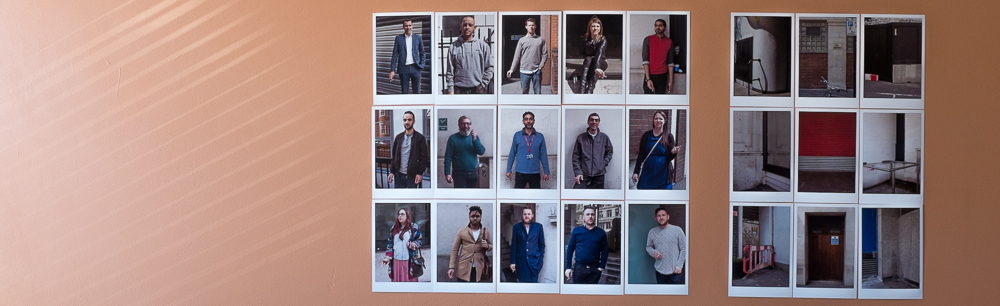
places where people who were smoking outside buildings had been smoking – april 2017


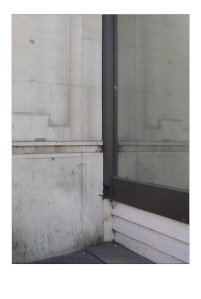
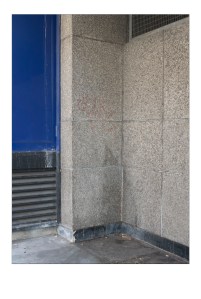
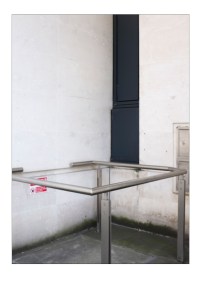
As mentioned in my previous post, easily as many people declined to have their picture taken by me as agreed to be included in my smokers’ typology. After a while, I realised that I could always take a picture of where some of them had been standing, after they had gone. I tried to keep the focus slightly in front of the wall, where the smoker would have been and tried to make interesting compositions that would work with the others in a grid.

Here they are. I quite like the effect and probably would be more likely to have these printed, framed and hung on a wall somewhere than the ones that actually have people in them.