Category Archives: Part 1

getting to know your camera # 4

Photographing Movement – Stationary Camera With A Variety of Shutter Speeds

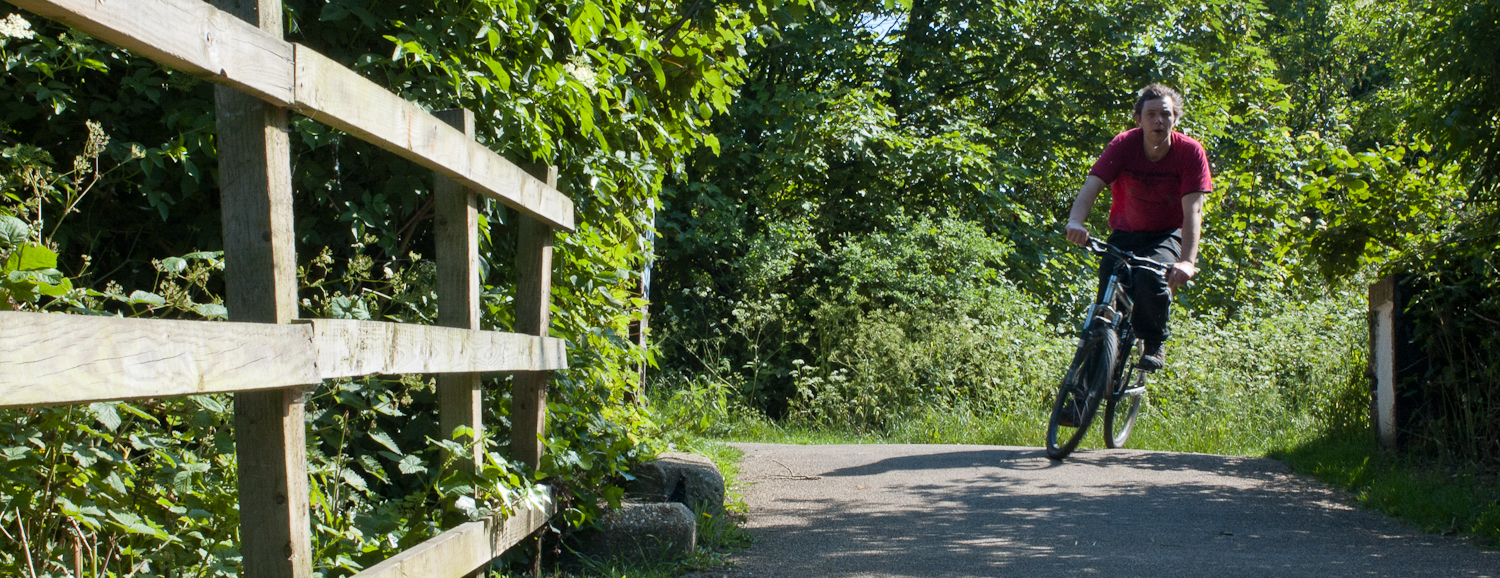
man on a velocipede

Nikkor 1/1.8:50 AF-D; f22; 1/8th sec

Joggers, cyclists and dog walkers are found in abundance in the parkland that stretches down the Lea Valley from Tottenham Hale to the Lea Bridge Road. It seemed a good choice for the exercises featuring movement at varying shutter speeds. For the series taken with a fixed camera, I set up a Nikon D50 low on a tripod, pointing up the long stroke of a T-junction. The camera was triggered using an infrared remote. I used a 50mm lens, capable of stopping down to f22 as this would give me the widest possible range of slow speeds on what was a very bright day to be using a camera with a lowest ISO of 200. The resulting shots cover a range from 1/8th of a second to 1/400th of a second.

1/8th sec – runner
runner 1/8th sec

Nikkor 1/1.8:50 AF-D; f22; 1/8th sec

Almost melts into the air, leaving an elongated series of brushstroke-like traces as he goes. good for a highly abstracted sense of movement. His grounded foot remains stationary for the time the shutter is open (and will only begin to move as his trailing leg moves past it and the heel starts to rise) meaning that the Nike swoosh on his running shoe is the only fully identifiable part of him.

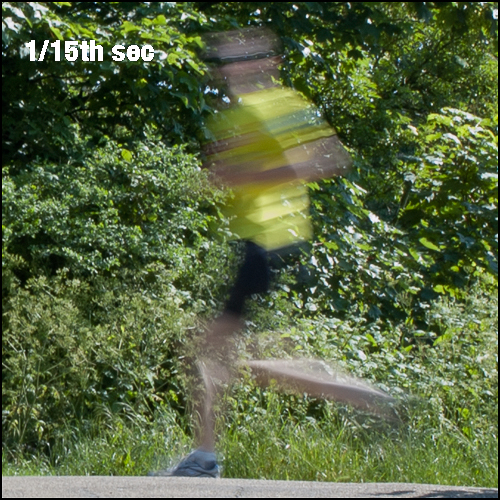
1/15th sec – runner
runner 1/15th sec

Nikkor 1/1.8:50 AF-D; f22; 1/15th sec

A more identifiably human presence – you can tell that a man in a yellow top and black shorts, wearing sunglasses has looked to his left as he passes the camera. He has been caught at a different point in his stride from the previous shot and his grounded foot has started to move although his trailing leg is less elongated. Against a more neutral background I think this would work nicely.

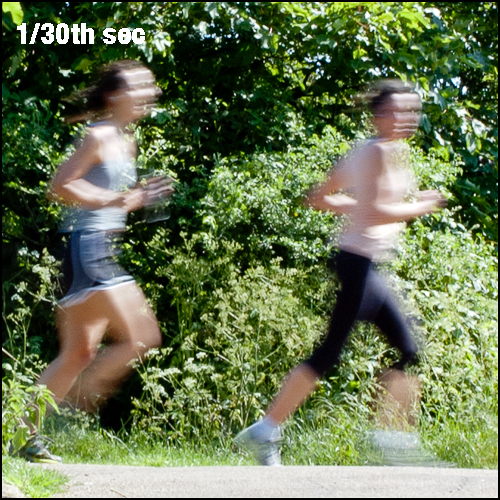
1/30th sec – Runners
runners - 1/30th sec

Nikkor 1/1.8:50 AF-D; f22; 1/30th sec

Neither figure is as pleasingly caught and blurred as in the previous shot, but the leading woman is the better of the two as she is further from the point where the two legs and arms cross the body rather than stretching out in front and behind. Gauging a shutter speed appropriate for the speed of movement is important, but so is timing relative to the stage of the action photographed.

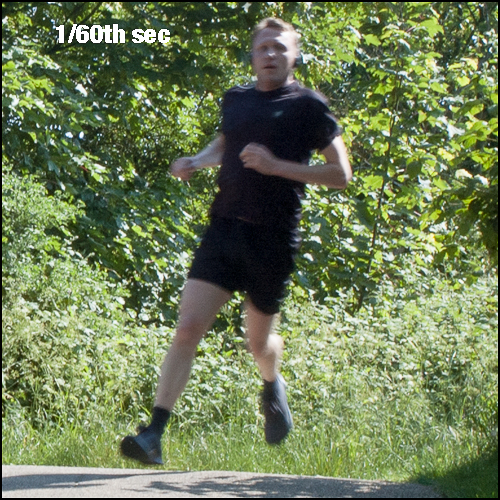
1/60th sec – runner
runner 1/60th sec

Nikkor 1/1.8:50 AF-D; f22; 1/60th sec

He is crossing into the frame around the corner, rather than parallel to the plane of the sensor and so his relative movement is therefore less, and the effect is simply that he is out of focus. This creates a slightly troubling effect given that there are objects both behind him and between him and the camera that are firmly in focus. Given that his feet are both off the ground, this particular shot might have worked better with a much shorter exposure leaving him hanging frozen in mid air…

1/125th sec – walker
woman walking, 1/250th sec

Nikkor 1/1.8:50 AF-D; f22; 1/250th sec

She is moving more slowly than he is but like the runner above she is simply a bit soft within a sharp frame. Presumably she has covered a similar distance relative to the camera plane. The timing of the exposure relative to her movement is nice however – she is obviously mid stride.

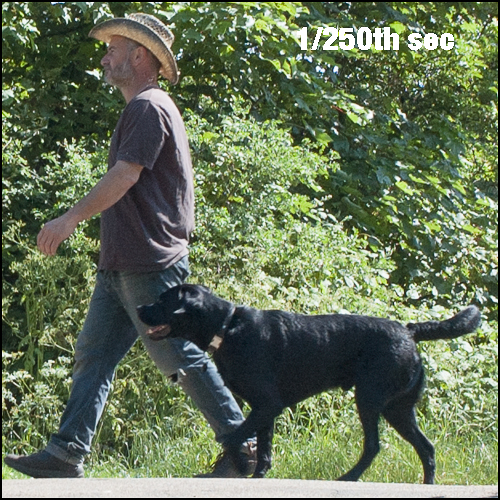
1/250th sec – walker with dog
walking man and dog 1/250th sec

Nikkor 1/1.8:50 AF-D; f22; 1/250th sec

Pretty much frozen, apart from the dog’s front-left paw. Not bad.

1/400th sec – walker with dog
man and dog walking, 1/400th sec

Nikkor 1/1.8:50 AF-D; f22; 1/400th sec

Frozen, but not as nicely timed as the previous shot; the man’s okay but the dog’s legs are a bit of a mess in timing terms.

Conclusions

Different speeds of movement will require different exposure times to get the desired effect. Similarly, different directions of travel relative to the camera will effect the impression of movement. Timing the shot relative to the stage the subject’s movement has reached is also important. There is an area between extreme motion blur and frozen that is less successful than either extreme, for movement involving legs at any rate. In every new situation, you will probably need to experiment a bit before you determine where the sweet spots are, based on time, direction of movement and the desired effect. I suspect it would be good to revisit Muybridge’s work

The last 3 pictures feature a couple and their labrador who wondered what I was doing and then – after I explained – offered to do the last few passes, saving me some time waiting for someone to turn up naturally. Thank you, anonymous couple – I realise I should probably have got their names, and let them know somewhere where they would be able to see the pictures, like here!
a couple of hours in the necropolis

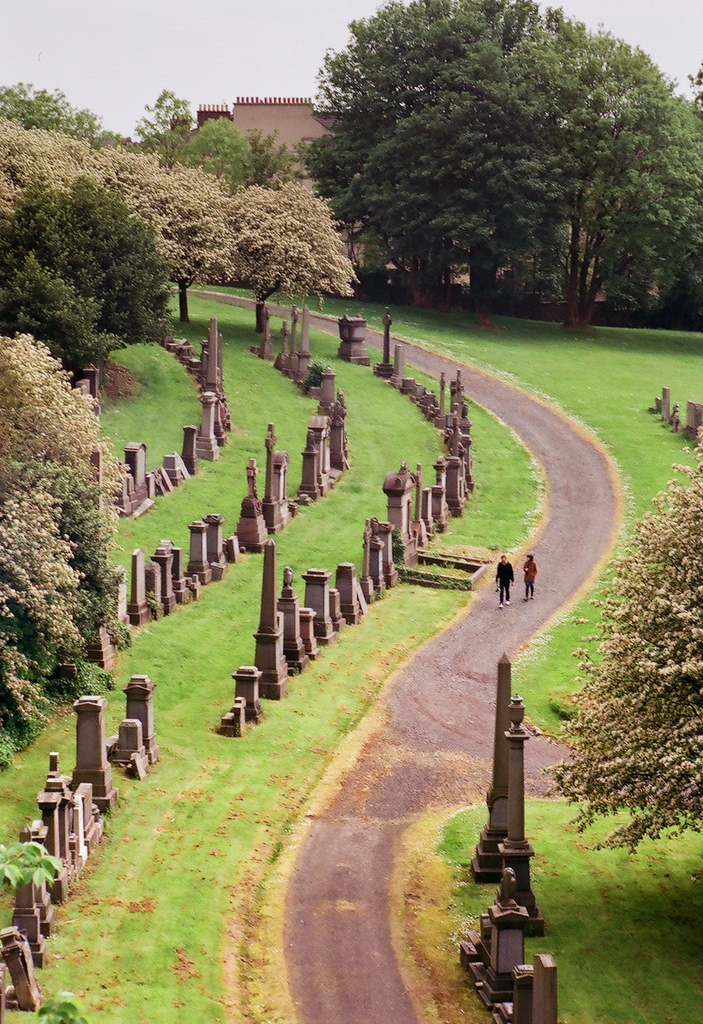
looking east from the necropolis, glasgow

Pentax Spotmatic F. Jupiter 9 1:2/85 1/250th sec @ f11. Fuji Superia 400 asa

(Notes on my shoot for the fourth exercise in part 1 – using different focal length lenses from a fixed position)

This weekend I had a couple of totally free hours that I filled by going to the Necropolis for the first time in around 30 years. Back then it was all fairly dilapidated – I think you weren’t even meant to go in in case a vault collapsed under you – but now it’s been cleaned up, made sound and become part of the tourist experience.

As I spend a fair amount of time in Glasgow, I keep a Pentax Spotmatic-F and a set of lenses there to cut down on the amount of luggage I need to take with me when I travel up from London. Glasgow is also where I get film developed, at the Snappy Snaps on Byres Road, so if I finished the film I already had in the camera, there wouldn’t be a delay in viewing the results.

The Necroposlis sits on a steep hill separated from the cathedral by a steep valley and if you look back as you follow the twisty path up towards the monument to John Knox, there is a fine view west. I realised that this was probably as good a place as any to work through lenses with a variety of lenses:

  • Super-Takumar 1:3.5/28
  • Super-Multi-Coated Takumar 1:2/35
  • Super Takumar 1:1.4/50
  • Jupiter 9 1:2/85
  • Super Takumar 1:3.5/135 (2 shots, the second with a x2 teleconverter)

The camera was on a tripod, but some adjustment was made for composition as the frame tightened. All exposures, 1/250th second at f11. Film used 400 asa Fuji Superia.

The picture at the top of this post was taken later, on the other side of the hill looking east. It may form part of Assignment 1.

getting to know your camera # 3 – focus at different apertures

oca-0.3-3

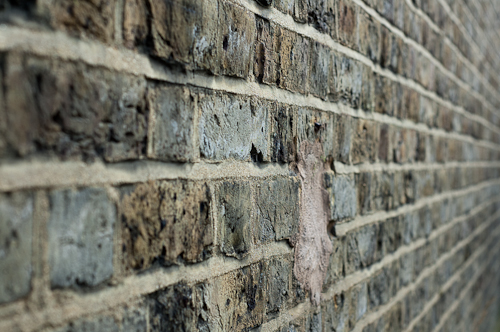
All three photographs were taken with a Nikkor 50mm 1:1.8 AF-D lens on my Nikon D50. Focal length equivalent of around 75mm on a full frame camera. ISO was set to 200. Shutter speed varied according to the aperture.

oca-0.3-1

f1.8: A very narrow depth of field; almost everything except for a narrow band down the centre of the image is out of focus; moving out from the focussed strip the quickly becomes very blurred indeed.

oca-0.3-2

f6.3: A wider area of brick is in focus, stretching with a greater increase to the right of the image, where the wall was further away from the camera. The entire image is now readable as brick.

oca-0.3-4

f22: The strip widens again, and – unless you look closely – most of the picture seems clear, if not completely sharp. This time the increase seemed evenly spread on either side of the original in-focus area, which suggests maybe I knocked the point of focus off to the right when I was changing the aperture.

Nothing to add to this really; the smaller the aperture the greater the depth of field. It’s always interesting to do exercises like this and see in practice what the theory says…

getting to know your camera # 2 – focus with a set aperture

For this, I made more than one series of photos, trying to get different relationships between the in and out of focus areas, and to try different types of subject matter. In all cases, I used a 50mm lens at f1.8 on my D50.

First I tried framing something with no obvious subject that demanded focus – a section of my neighbours’ privet hedge, focussing on different areas of leaves, working from left (near) to right (far):

oca-02-3

None of them particularly wows me, but the third, with a narrow in-focus area to the right of the frame is the least interesting with the nearer, out-of-focus leaves creating a sense that I’m pressed up against something, trying to see beyond it. It might work if there was an obvious “thing” that was partly obscured, giving some sort of spying/surveillance feel to the shot, but here there’s nothing to suggest that sort of narrative. The second (focussed on the middle of the frame is okay, but unengaging; the first comes closest to working by dint of having an identifiable, in-focus subject (some foreground twigs) and also, I suspect because I am conditioned to scan pages (and pictures) from left to right and here I don’t start off with an area of no focus before settling on an in-focus area to the right of the page.

Next I took a subject where the planes we more obviously distinct – a swing in a playpark – and focussed on the textured matting beneath the swing (far) the swing itself (middle) and one of the supporting ropes (near):

oca-04-3

There is something to look at and treat as a subject in each of these , with the texture of the in-focus area helping to settle the eye, but the middle picture with the swing in-focus between two out-of-focus planes is probably the most easy to project into some sort of three dimensional space while the other two are less complex, consisting of something on top of, or in front of an in-focus object. This preference is probably enhanced by the strength of the blue and red versus the more muted colour of the faded red rope and the green matting.

My final go at this exercise involved setting the focus on different people in front of me on the long escalator down from the 2nd level at Tate Modern:

oca-04-2

Again, all three work in the sense of giving subject status to the thing in focus with the least successful being the one where that subject is not doing something (the one on the right, which was in fact the first to be taken). The centrally focussed picture with the man kissing his girlfriend is  probably the most comfortable to look at; the one on the left with the young man looking off to the upper right of the frame is also good, but there is an element of tension introduced by the man on the up escalator  (who I wasn’t really aware of as I took the picture) who is equally in focus and looking up into the frame, causing the eye to move back and forth over the central out of focus couple.

In all three series there is a sense that the thing in focus needs to be worthy of the attention before the picture works. Where this happens, the viewer is placed into a relationship with the subject that locates both of them within three dimensional space. Further to this, there is also a sense that other elements – colour, contrast, the possibility to construct a narrative – can support or undermine the effect of where the area of focus starts and stops. Lastly, there comes a point where the in-focus area can be too close to the edge (the third swing picture with the focus on the rope is a good example) where your eye is drawn out of the picture, away from the centre and other side of the frame.

sunday on the marshes

Walthamstow - Shutter Speed and Motion

Nikkor 35mm f2 AF-D; 1/60th; f22. ISO 200.

A good, productive morning, taking the pictures for the last two Getting To Know Your Camera Exercises (the movement ones) and also managing to get raw material for the first two of the Framing Exercises.

I headed down to the Lea Valley Marshes and spent the best part of an hour with my D50 on a tripod, focussed on a t-junction where there was likely to be a fairly steady stream of cyclist, joggers and people walking dogs, working through shutter speed and aperture combinations, and then crossed the river into Clapton, sat on a bench set a little back from the navigation’s tow path and panned with cyclists as they went past.

For the second framing exercise (Objects in Different Positions in the Frame) I took advantage of the numerous flight paths that cross the Lea Valley and the cloudless blue of the sky to take pictures of planes as they went overhead. Startlingly difficult, using a long lens (the full extent of my longest zoom is 300mm) to keep it all steady, shoot, reframe and not lose the (auto)focus. I think I have the pictures I need, but took way too many…

Then, on the way home, for the first of the framing exercises (Fitting the Frame to the Subject) I noticed a unit (?) a stockade (?) – it certainly isn’t a shop or a garage –  selling tyres, with a fair amount of signage outside, and decided to try a sequence of pictures of it, rather than go out again later and use a nice, orange and west-facing (so not lit yet) corner shop as the subject of the exercise.

I’ll write up each exercise separately, once I’ve edited the pictures for them…

So, a lot of ground broken, but plenty to do in terms of analysis and writing everything up. Two immediate thoughts on the days shooting: the first ties into the ethical question of whether its ok to take pictures of people in public spaces  the other regarding my rather tired digital camera. Both of them are covered in other posts, here and here

how normal is normal anyway, pythagoras?

One  footnote to the first of the introductory exercises is that I finally did the sums to work out the “normal” focal length for both a frame of 35mm film and for my smaller DSLR sensor and was slightly surprised to discover that:

DSLR: 23.7 squared + 15.6 squared = 805.05 or 28.4 squared: – ie the diagonal = 28.4mm

Film: 36 squared + 24 squared  = 1872 or 43 squared – ie the diagonal = 43mm

So, rather than being normal, a 50mm lens is ever so slightly telephoto and the nearest I can get to a normal angle of view with a prime lens on a film camera is my Olympus Trip 35 with its 40mm fixed lens. And on my DSLR I need a 28mm lens rather than the 35mm one I’ve blithely been using for ages now.

So there…


getting to know your camera # 1 – focal length and angle of view

A straightforward exercise and something I’m surprised I’ve never actually done before. For it I used my Nikon D50 body, Nikkor AF-D 35-70mm f2.8 zoom at both ends of its range and a Zenitar 16mm f2.8 to give a final, wider version of the view. I was interested to see that – when looking through the viewfinder with the other eye open – sizes didn’t match at a focal length of 35mm (the normal/50mm equivalent for my camera’s sensor) but did when the lens was zoomed in to about 50mm. While the angle of view was correct for the 35/50 equivalency, optically the perceived size was correct only with a tighter focal length. Presumably this means that my “sensor size” (the retina of my eye) is closer to the frame size of 35mm film and while it is seeing a narrower angle through the viewfinder (approximating to a 75mm lens on a film camera) the visible size of the objects seen remains the same. Certainly, a couple of days later, trying a 50mm lens on a film SLR, it was still the 50mm lens that gave the same perceived size in both eyes. Now, it would be worth trying this with a medium format SLR and a 50mm lens, just to check whether a 50mm lens – acting as a wide-angle this time – would show objects the same size in the viewfinder as they appear through the other eye in reality.

Anyway, here is a composite of the three shots I took, with the tighter angled pictures scaled down to the equivalent size in the widest and then pasted over the original with the frame’s edges outlined:

Image

When I returned with 3 A4 printouts, I was just able to get my hands far enough away from my face for the 70mm picture to match the size of the original, the 35mm picture was ‘right’ with a slightly obtuse angling of my elbows and the 16mm picture would have needed to be too close to my face for me to focus.

Of course, I forgot to take a tape measure with me, but – back home with a ruler and relying on muscle memory, or whatever it’s called – I was able to estimate the distance at which the prints matched up in size to the view as being 70cm for the tightest and 35cm for the middle one. The widest was impossible to gauge, but it seemed to be almost right when the paper was around 10cm from my face; from the other two, it presumably would have been about 16cm given that (for an A4 print) focal length in mm equals arm’s length in cm…