Category Archives: The Art Of Photography

My Learning Log for the Level 4 Open College of the Arts’ course, Photography 1 – The Art of Photography

Assignment 4 – Getting There

AoP-4.6-banner

“Choose any subject that you can move around and take 8 photos based on the 4 themes of the assignment. ” – AoP Coursebook
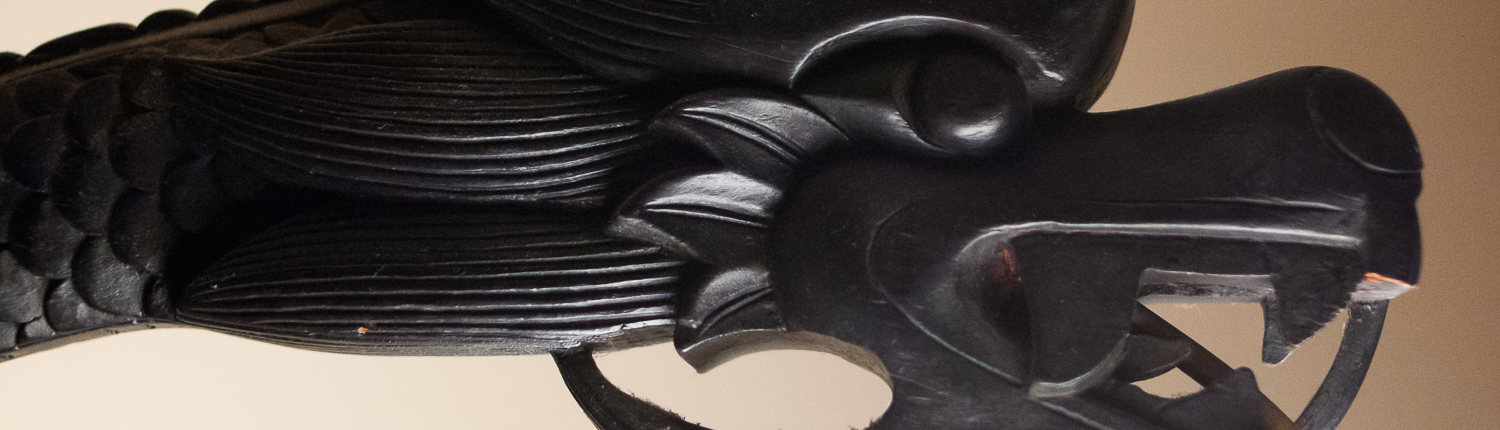
The themes for assignment four were Shape – the 2D aspects of the subject – Form – the 3 dimensional aspects of the subject, adding depth to the outline – Texture – bringing out details of the surface – and Colour – which I took to relate both to the colour of the subject and also to the colour of the light falling on the subject.

So, the first task was to choose a subject that gave enough scope for all four of these to be shown, without too much repetition between pictures. I also wanted to use a variety of different sorts of light for this, using daylight and artificial light and also specifically photographic lighting to gain the effects required.
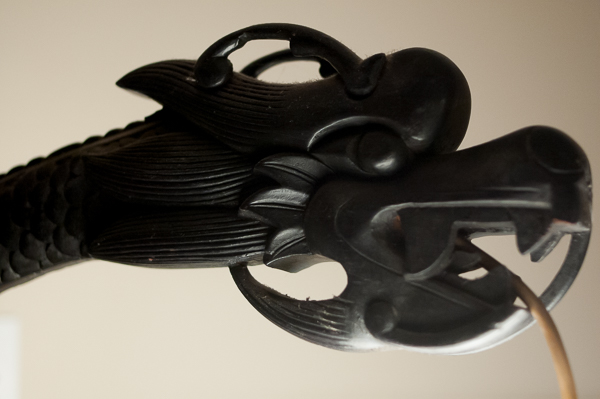
the dragon lamp

the dragon lamp

I started looking at lights that were already present in the house with the idea of the subject lighting itself in some of the pictures, settling on either an anglepoise-type lamp which offered a lot of nice, variable geometry or a 1920s wooden standard lamp in the form of an oriental dragon which would produce more diffused light through its paper lantern lightshade.

anglepoise lamp

anglepoise lamp

Shape and Form would be fairly easy to get, with the anglepoise offering a wider variety of silhouettes and the chinese standard lamp offering more interesting possibilities to cast shadows bringing out its form. There was plenty of texture in the carving of the standard lamp while the anglepoise had a rough cast iron base and silvered springs which would make fine closeups. But both were black: colour would be a bit of a problem although one picture contrasting the orangey light of the lamp itself with white, photographic light would be achieveable as would trying to give some idea of depth by using two lights coloured with gels to give contrasting (red in the foreground and blue further back) highlights.

I had already discovered the amount of space needed to light a subject during the photographic lighting exercises that led up to the assignment; the attic where I have my workroom probably wouldn’t be large enough to do wider shots of the standard lamp while clearing the living room of the clutter left by me, my partner and our 2 year-old would present problems.
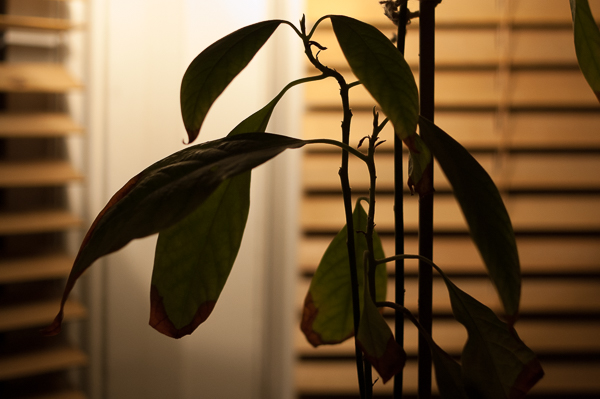
AoP-assignmentWIP-4-4I put the idea on hold, while I tried to think of other more easily isolatable subjects, coming up with a typography of old Russian cameras – again, good shapes and nice textures but not a lot of colour – a battered old pair of shoes and an avocado plant, grown from a stone and now showing some nice structure for both the form and shape pictures, good textures on the leaves and trunk/stem and also a variety of colour in the leaves which contrasted nicely with the soil in the pot and the pot itself.

At this point however, the deadline for the assignment was looming and I just needed to knuckle down and shoot something; it was Valentine’s day and my partner gave me a bunch of carnations. As they fell into some sort of arrangement in a glass jug, I realised I had found my subject and also that the short lifespan of cut flowers would force me to work reasonably quickly. I cleared enought space in the living room to make a start and began making the pictures.

I will confine detailed notes and contact sheets to 4 of the 8 submitted pictures…
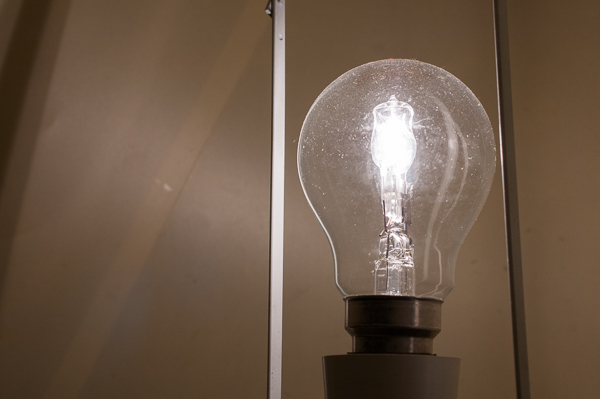
Keep a good head and always carry a lightbulb...

Keep a good head and always carry a lightbulb..
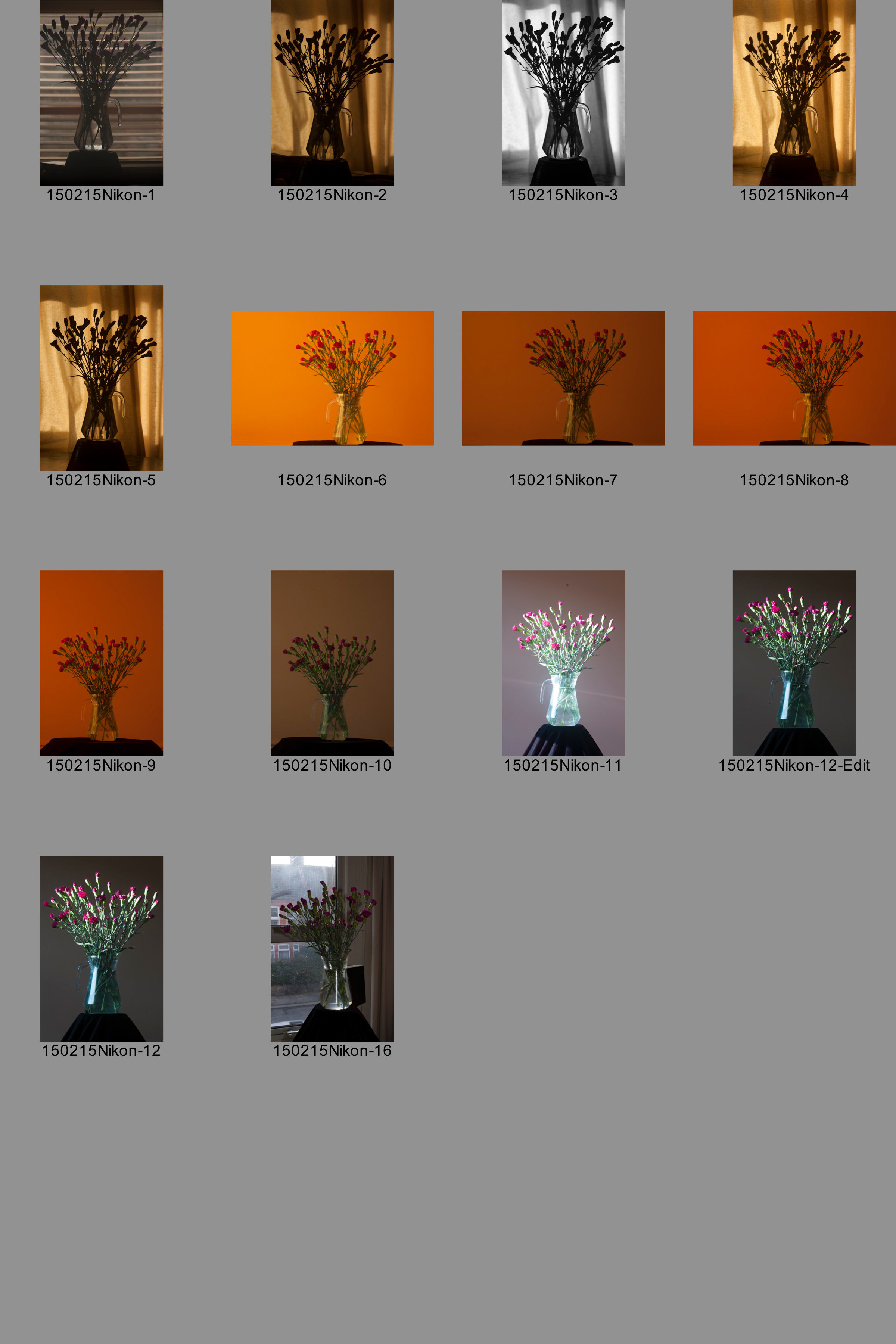

Contact Sheet 1 - Shape 1 & Form 1

Contact 1 – Shape 1 & Form 1

For the first shoot – trying to get a natural light Shape and Form – I put the jug of flowers on a table in front of a window and then raised it on an upturned earthernware plantpot so that the base of the jug was inside the area of the window. I took an initial shot using a venetian blind to control the intensity of the light somewhat, but did not like the effect (shot 1 on the contact sheet); instead closing the curtains gave a much softer diffused light while the folds of the cloth gave some variety to the background without being as disruptive as the hard horizontals of the blind.Liking the overall effect (shot 2) I took three further shots made with the same exposure, but varying the aperture to give an increasing depth of field to try and catch the outline of the whole bunch of flowers in focus. (check exif).

I then shifted the camera 90 degrees so the light was coming from the side of the frame rather than directly towards the lens. I experimented with trying a landscape formatted picture, but felt that – without something interesting on the background (shadows, perhaps) – the flowers suited a more vertical treatment. The low evening light was quite strongly warm, particularly when filtered by the oatmeal curtains. I tried different white balances, but overall did not like the resulting muted colour and lack of contrast (10 on the contact sheet). I drew the curtains to get more contrasty, undiffused light. I had draped a wider support (a cable drum) with black velvet to cut down on internal reflections but as the sun sank outside this did not raise the jug high enough for it to remain evenly lit, so I went back to using the upturned plant pot, but this time draped with the cloth. The effect was better, but the light hiting the water-filled jug reflected a sharp shaft of light on the wall behind the flowers (shot 11). To stop this, I taped my notebook to the back of the jug (shown in shot 16) and took the final shot. Annoyingly, you can just see the notebook to the left of the jug’s bottom (12) but – with the light vanishing for the afternoon and tea needing to be served on the table – was able to clone it out later (12-edit, the submitted image).

Contact 2 - Form 2 becoming Colour 1

Contact 2: Form 2 becomes Colour 1

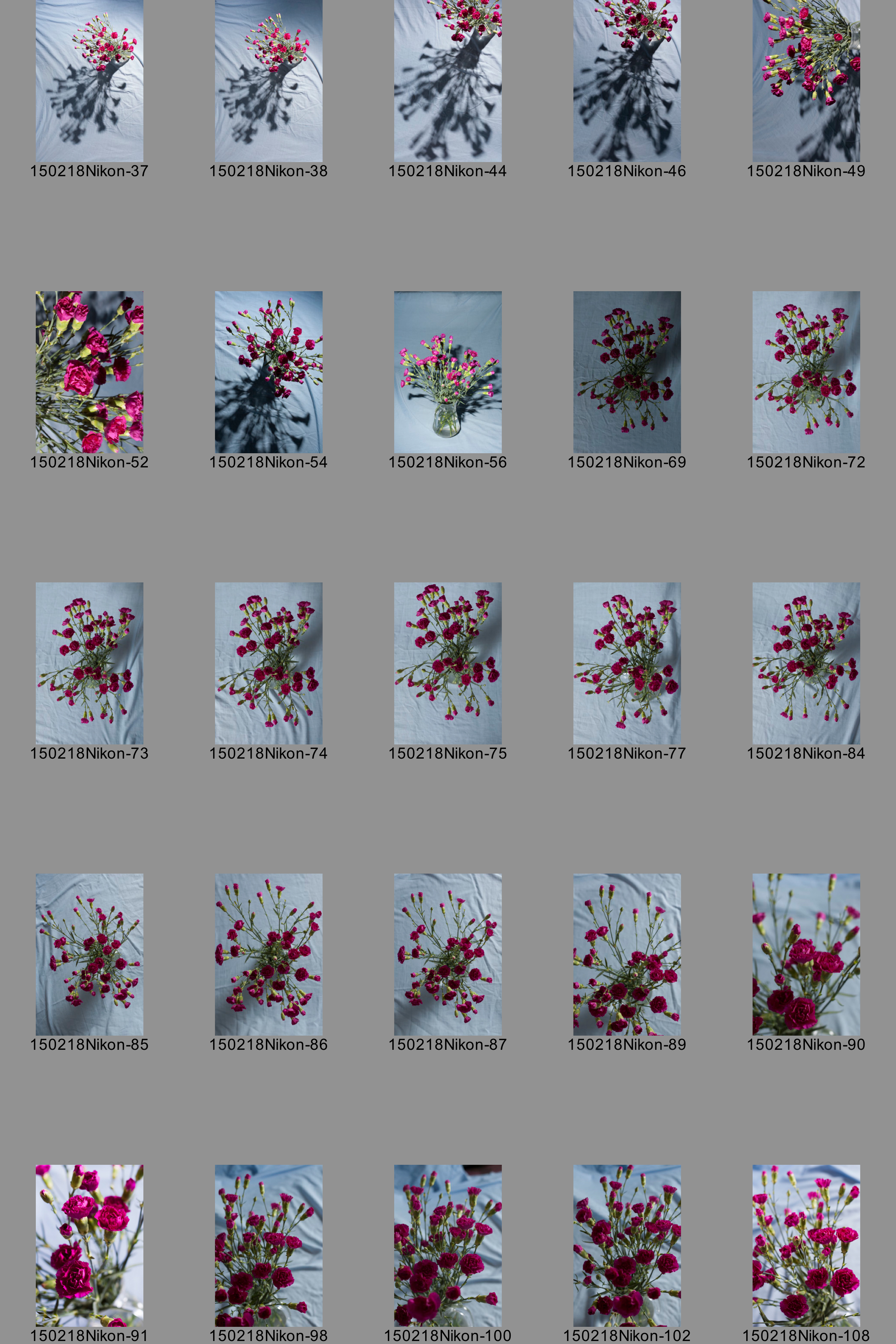
I thought it would be fairly easy to get a flash-lit form picture using a plain background (a pale blue sheet)and a relatively strong undiffused strobe set to give a wide beam of light to cast nice sharp shadowws. Shooting down into the vase I thought I would effectively get a front and side elevation combined in one picture to give a stong idea of the 3D shape of the subject. I was wrong…

Firstly, getting the sheet anyway near flat enough to not cast distracting shadows proved almost impossible. And the strong contrasty light was focussed by the lens-like effect of the water in the glass jug, drawing more attention to the background than the flowers. Moving closer (44 and 46) gave a better effect than the wider shots I started off with, but it never quite worked for me at the time. In retrospect, I quite like some of them now, but still think I’d have needed to do more work to get them just so: rearranging the flowers to hide the hot spot; maybe raising the whole set up up and taping the sheet to a wall so I could work along the horizontal axis, rather than looking down on the jug of flowers while gravity pulled the ruckles out of the sheet. I almost got to this set up by draping the sheet over the front of the couch (56) but lacked the height I’d have had with the flowers on the table and so couldn’t really get the strobe low enough to send a shadow out straight to the side. It would also have allowed me to set the camera on a tripod and work on small improvements to lighting without worrying about framing and where I wanted the shadow to fall.

But instead, I gave up on the hard shadow 3D effect and instead added a shoot-through umbrella to the lighting setup, diffusing the light and losing a lot of the shadow; I also started working closer (69 onwards) losing the sense of 3 dimensions as I moved in but gradually becoming aware that the magenta of the flowers was nicely set off by the pale blue of the sheet, while the green of the stems stood out on the other side of the blue. Rather than a form picture, I was making a colour one. Picture 90 (the number of pictures shows the other downside to not using a tripod – rather than being able to sort the framing and then concentrate on the lighting effect, I was constantly reframing as well) is the one that I plumped for in the end; it also works at giving an idea of depth, thanks to the shallow focus and isn’t bad in terms of the texture of the flowers either, but the colour I think is closest to the effect of the carnations in reality…

Contact 3 - Colour 2 0.1 & 0.2

Contact 3 – Colour 2.0.1 & 2.0.2

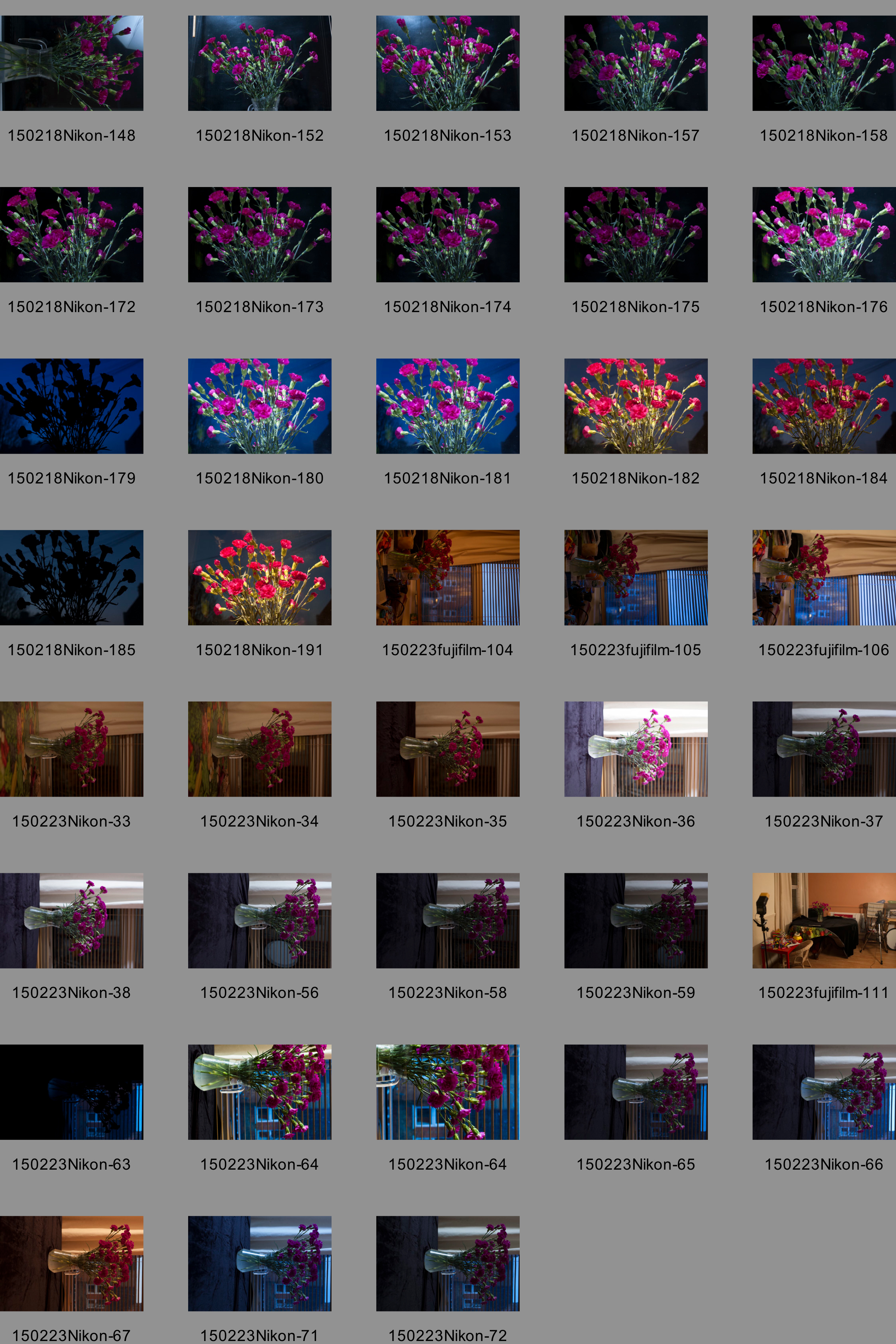
All along, I had wanted to combine tungsten light with daylight, limiting the background to blues while the subject was rendered naturally by adjusting the camera’s white balance setting to compensate for the orangey light of a filtered strobe. Dawn looking west would maximise the contrast, I hoped.

My first go – 148-191 – placed the flowers in the livingroom bay window, relatively close to the pane and with the light high up to the left of frame in an attempt to avoid reflections of the light in the glass. I once again tried a landscape format composition (it left less vertical space for reflections to form and also was going to result in a nicer silhouette of the buildings across the street); I then blocked spill onto the background using a piece of black-wrap as a barn door on the window side of the strobe. I got the aperture part of the exposure correct; locked everything off and went to be. In the morning, I’d find out how long an exposure would be required to get a suitable blue outside and then take the picture.

Then in the morning, I realised that there were still reflections in the double glazed glass and also that getting the focus right in near darkness, was very hard indeed. I managed to crack the focus thing (a torch shone on the bit I wanted sharp allowed the autofocus to work much better) but couldn’t lose the reflections. I moved on to using much the same position as I had used for 1 and 3 with the jug in front of a different window (104-106) and adjourned til the evening. I then ran through the same process as the previous attempt this time realising that the problem with the view directly accros the street was that the houses opposite and their white window frames distracted from the actual subject and its colour while the brickwork didn’t end up blue enought for the effect I was looking for. I did however notice that he window shot from an oblique angle, into the corner gave plenty of blue, without either reflections or distracting detail (Contact Sheet 4, 33-42.

Contact 4 - Colour 2 1.0

Contact 4 – Colour 2.1

So, that night, before going to bed, I went through all the same steps again – although this time, I created a rolled tube of blackwrap to concentrate the orange coloured light form the strobe on the flowers, casting a shadow on the wall behind – only to find that the morning was not clear and birght, like the previous two days, but was instead really rather overcast (54-57) and so there was much less light from the window, resulting in a much longer exposure being required. I shot anyway, and rather like the effect, even though, after necessary slight adjustment of the WB form the cameras tungsten preset in Lightroom the blue is much less pronounced than I’d been hoping for.


I didn’t do a lot of editing on the pictures gathered, limiting myself mainly to cropping, with a little bit of getting the overall exposure closer to filling the space from black up to white. Some colour adjustments (beyond converting some of the final pictures to black and white) have also been made, if necessary, but this has been kept to a minimum…

assignment # 3 – tutor’s comments & re-edited set

I got the feedback for Assignment 3 in time for Christmas. Dave, my tutor commented: “The log is coming along well. I’d like to see a little more content generally but there is plenty of time for this over the next two chapters.” The fact that that I’m only posting this now, 3 months later shows that there’s still a fair bit of work to do on this front. I have done the exercises for both part 3 and part 4, but have been appalling at writing them up. I have no real excuse for this and can only say that my intention is to rattle them off in parallel with doing the narrative exercises over the next few weeks.

But now onto the main part of Dave’s feedback, relating to the pictures submitted for Assignment 3. The slideshow below is a revised set of pictures, incorporating the areas he identified as needing work. I’ll get them reprinted before I submit them for assessment. The original treatment of the pictures can be seen here.

This slideshow requires JavaScript.

Overall, the feedback was generally very positive – “Firstly I should say that the colour relationships were mainly all clear and well spotted so well done –this assignment is particularly difficult to do when out of the studio so you have done well. Your diagrams show that you are seeing the different relationships well and composing the frame accordingly, which is the primary objective of the assignment.”

Where it wasn’t positive, it was, I’d say, fair and tended to chime with what I’d thought myself as I was completing the assignment:

  • “There was one image that stood out as not really up to the quality of the others -AoP-A3-06. The sign and shop front are all a little soft from camera shake.” – Premier Halal Butchers is on my way home from the tube; I reshot the picture on a night when it was rainy enough for the neon to reflect back from the paving (Fig 6 in the slideshow above).
  • “The only overall concern I had was that you seem to have had a slightly heavy hand with the saturation controls –presumably in an effort to really make the colour relationships stand out. I would advise against this, you are better off keeping the colours a little more natural. […] The assignment is all about seeing the colour relationships when you are framing, not about creating or highlighting them in post-production.” – I had come to the same conclusion myself when I realised that some of the “accentuated colour” versions of the assignment pictures weren’t all that more accentuated than the “normal” ones; I had spent a fair bit of time isolating the colours I wanted to stress in most of the pictures, reducing the saturation and shifting the hue of things that reduced the clarity of the main colour relationship in the picture; some of the results were downright garish. Ugh! I have now restored the pictures to something much closer to what came out of the camera.
  • “I would like to begin to see is some effort to link the images in later assignments together thematically or narratively.” To an extent, I felt – and still feel – that these pictures all link together in the sense that they were taken on my way to or from work, and my original intention as I started to compile the set was to come up with each of the four categories containing one picture from each four sub-groups – Walthamstow, Public Transport, Glasgow and Oxford Circus with one night shot in each subgroup – but this quickly became more of a hindrance than a help in getting the assignment completed.
  • Finally, one of the pictures was picked out as having a rather tenuous colour-relationship, Fig 9: Red and Blue – London. Again, guilty as charged, I think. It’s probably only there as a throwback to the 4 public transport pictures idea. I shall go through the rejected pictures from the other shoots and see if I can find something that more clearly shows Colour Contrast through Contrasting Colours.

Throughout Part 3, I had been reading and thinking around the work of the New Topographics photographers; following on from this, Dave suggested I look at the work of a number of more contemporary (and more British) photographers, to develop further my thoughts on depicting landscape. I have worked through the list and have particularly enjoyed work by Jem Southern and Fay Godwin. One of the posts I need to write here over the remainder of the course is one that goes into all this more, as I try to make my thoughts on town and country, America and Europe, wilderness and “man-altered”, home and away, past and present etc etc coalesce into something I build on. Watch this space…

some thoughts on ‘constructing worlds’ at the barbican, london

looking through the exhibition space at the barbican

looking through the barbican centre exhibition space

I enjoyed this exhibition of photographs linking architecture and pictures hugely. As ever, I got there far too late in its run (it’s over next Sunday, the 11th); it would really be better to go early on and – if I like an exhibition – think about it for a bit and then go back again for a second look a few weeks later. What follows is not so much a review as a set of thoughts, written a few hours after walking through the gallery… Continue reading

colour # 1 – control the strength of a colour

Find a strong, definite colour – a painted door for instance – and choose a viewpoint so that the colour fills the viewfinder frame. Find the average exposure setting […] Then take a sequence of pictures; all composed exactly the same, but differently exposed from bright to dark.

Arrange the […] images together . Apart from the obvious fact that the […] photographs vary from over-exposure to under-exposure, what other difference is there in terms of the colour?

– AOP Coursebook.

The photos that follow were all taken on a sunny afternoon in my back garden using my D50 with a 35mm 1:2 AF lens on it. They are of a Camden Council recycling tub that I’ve used as a laundry basket ever since I moved north of the river at the turn of the century. There are seven pictures rather than five, because it was only a few weeks ago that – playing with the various menus on my camera – I realised that I could set the increments by which exposure compensation worked at anything other than 1/3 of a stop. Further evidence if it was needed that you can never spend too much time playing with your camera…

All h-s-l values were calculated in Photoshop Elements 6 for Mac and were based on the centre of the embossed cross.

From looking at the the pictures, I can see that the lightness (brightness in Adobe-land) does indeed decrease quite dramatically as the sequence goes on; the saturation likewise increases and the colour temperature (hue) moves up from being closer to cyan to a much more obvious blue and end almost in the region of violet. The truest blues seem to be in the three pictures starting with the one shot at the meter reading and continuing into slight underexposure.

Likewise, doing the same thing with a red storage tub and a yellow council grit container showed similar results, although the red showed a slight drop off in saturation below an average exposure and yellow seemed most saturated either at average or slightly higher.

I’ll have a go with some pictures containing more than one colour, to see if I can emphasise a particular colour by choosing the correct level of under (or over) exposure while reducing the impact of the others.

(Postscript – I have also played with one of the standard exposure pictures and have found that  – providing the highlights or the shadows aren’t clipped – a raw image can be moved up and down the exposure range in Lightroom, creating the same colour effects to my eye as can be created in camera by altering the exposure; another thing to try while editing, I guess …).

assignment # 3 – colour: pictures and commentry

Take about sixteen photographs:

This slideshow requires JavaScript.

…that illustrate the following colour relationships:

1: Colour Harmony through Complementary Colours

I spotted the building while I was walking from the subway on my way to a meeting at Pacific Quay. On my way back, I had enough time to loiter, waiting for people to walk by in both directions. The pale orange of the brick is matched by the reddish orange of the trim to the gable and the door and contrasts nicely with the pale autumn blue of the sky to the north; I like the tiny bits of colour reflected in the gutter. A very flat image (with flat lighting – it was taken at noon)  with a lot of horizontal lines running through it: the kerb, the line in the middle of the road and the bottom of the building wall; the diagonals of the gable add interest. The eye moves between the two points made by the door and the walking man (who is surprisingly close to the wall, if you look closely).

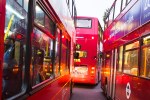
The orange and blue of the sign stands out strongly here and there’s lots more of both colours in the traffic and the pedestrians who occupy the space round it. Your eye moves then to the green and red barriers that enlose the sign, making an inverted vanishing point in the centre bottom of the image, with the red also turning up as highlights in the fragments of distant buses on the road and reflected in the plate glass of the window on the right.

An astonishing corner on the Lea Bridge Road, composed as four quadrilaterals united by the sense of movement provided by the striding man in the jersey that managed to be a gloriously matching blue to the door.  There’s a minor violet and yellow thing going on in the upper right quarter as well. There is an interesting absence of any scale to the various bits of the building too.

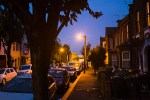
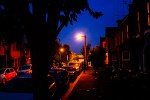
Essentially a diagonal band of orange, a diagonal band of blue and a second diagonal band of orange, with your eye drawn to super-bright highlight of the central streetlight, which is casting all the yellowy-orange glare in the street. I’ve been walking on my way home from the tube at dusk a lot these past few weeks, and this is probably the best representation of it that I’ve managed to take.

2: Colour Harmony through Similar Colours

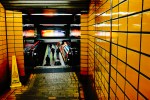
Lots of lines pointing in towards a vanishing point on the platform, held together by the overall warmth of the colours in the station. The lightness of the yellow contrasts to the dark orange-brown of the tiles where the stair dips down to the platform while the brigthness of the orange (sort of) cross formed by the sign, its reflections and the train give a focus and depth to the picture.

Reflections after rain stop this being boring, while a walking man (central and pulling the attention in from the edges of the frame) gives the composition focus and a point of balance. The violets in the this are very cold somehow, with the reds providing no sense of warmth.

Despite the sense of forward movement into the space between the nearer two buses here nothing was moving (possibly a faster shutter speed might have spoiled this while sorting out the slight sense of softness across the image) and I was safely stood on a crossing in the middle of Walthamstow Bus Station. Again, there is something quite cold about the image, despite the warmth of the colours.

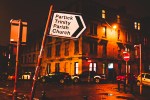
More streetlight, mostly a rather bilious yellow provides an out-of-focus backdrop for the leaning sign. Despite the possible depth off to the left and the right, a rather flat image.

3: Colour Contrast through Contrasting Colours

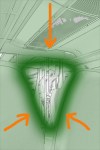
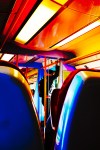
Red and blue fighting one another with the orange relating to both (opposite to blue and comfortably similar to red) and so making it less uncomfortable somehow. compositionally arranged around the triangle betwen the seats occupied by the man and his rucksack.

A striking yellow gable end with the shadow of a perpendicular row of houses cast on it by the late afternoon sun. The blue of the eastern sky contrasts with the yellow strongly.

Nice shapes at the entrance to work. For some reason on the day I took it, I was able to notice the strong contrast between the yellow of the artificial light inside and blue light coming in from the windows to the west. Compositionally a mass of quadrilaterals, capable of further abstraction.

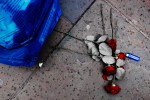
An objet trouve. A strong colour contrast between the red of the flowers and the blue of the rubbish sack and the lighter emphasises the softness of the abandoned roses and the hardness of the plastic; the light green of the leaves’ underside contrasts with the red of the flowers while stopping the blue jarring as much as it might. The lines between paving slabs and the stems of the roses adds a sense of movement through the frame.

4: Colour Accent using any of the above

A very centralised composition with the cyclist frozen within a a central diamond formed by the cars’ slanting windscreens, the roofs and the tree. An obvious orange point amongst the blues and greens of the foliage and the sky’s reflections on the shiny surfaces of the cars.

Taken through a 1 inch square mesh, covering a window on the hoarding that surrounds this building site, hence the vignetting at the bottom of the image. I got the lens in a better place for this with a second shot, but the man’s legs were no longer in a perfect inverted ‘V’… The picture is further held together by two triangles (or one quadrilateral) formed by the man and the two orange-red bands above him on the building and the orange net at the bottom left.

If William Eggleston can do pictures with their composition based on the confederate flag, I can take a picture composed like a saltire. Particularly when I’m in Glasgow. The greenish-blue of the building, the sky and its reflection in the puddles along with the green of the leaves contrast strongly with the red of the no entry sign.

The sight-lines of the woman at the bottom left and the man taking up the whole of the right side of the frame all point in towards the woman in the red coat, with the colour hopefully stopping the tall man in the hat being the sole focus of the picture.

All pictures taken with a Fujifilm X-100s apart from Fig 3 which was taken with my Nikon D50 and a Nikkor 24mm 1:28 lens. All editing on the main images done in Adobe Lightroom 5.

More general thoughts on these pictures and how they relate to my reading will be contained in the next post.

Assignment 3 – Getting There…

For some reason, I’ve found part 3 amazingly difficult. If part two fell into shape around my day on Flotta, this all felt remarkably unfocussed somehow. I was taking pictures – some for the exercises; some which could be considered for the assignment – but none of this seemed to cohere into a theme or to even to start showing the way towards one.

a3-intro-header

I have now got the pictures for the exercises, I think, but I still need to make a final selection and write them up. I have a set of photographs edited and printed for the assignment. Yet somehow it all feels a bit wooly. However, I think if I press on and do the writing, submit the assignment and write up the exercises, start on part four and carry on reading and thinking, it may all become a bit plainer. An optimistic reading would be that any sort of learning involves stepping into areas of uncertainty and that the way I feel about this now is simply a sign of progression. I shall therefore try to be optimistic and assume that I am still progressing…

Anyway, buoyed up by David, my tutor’s, feedback on my second assignment, I cracked on with part three. I’d generally felt comfortable with colour, and there weren’t many exercises. Surely this should be relativeIy straightforward. So, I quickly took the pictures for Exercise 1 and began to build up a selection of dominant colour pictures for Exercise 2. I began seeing things which would possibly work as part of the assignment and started to take pictures.

At this point, I started trying to reconcile the course notes’ instruction to:

Try to vary the subject matter, including both arrangements (such as a still-life) and found situations.

with my desire to try and develop a coherent theme for this exercise. Not easy.

I came up with 4 subsets for the pictures I would take: at night; on public transport; Walthamstow; fruit and veg as still lives. It almost came together…

But then I had a weekend in Glasgow and managed to take some pictures that seemed better than the ones I’d taken previously but they didn’t fit into the categories; and I hadn’t managed to set up and take the still lives, despite spending a long time in the greengrocery aisle in Sainsbury’s wondering about colour rather than recipes; and certain colours and combinations of colours were proving easy to find (it’s amazing how much orange and blue there is out there) while others were really quite elusive.

At this point, I sort of ground to a halt in terms of completing the assignment, although I continued taking pictures. Some things though began to stand out.

Orange rainwear/hi-viz bibs make a good highlight:

It’s relatively hard (but not impossible) to isolate natural colours, if you’re in a city:

It’s even harder to narrow down the number of colours that are in the frame into something you can classify in the terms of the assignment:

I also began to realise that something was altering the way I took pictures in London. In Orkney, on holiday, I’d been comfortable with the location; Assignment 2 bears this out. London, on the other hand, is a place I haven’t quite worked out how to photograph yet. This may be changing. Certainly, I hope it is.

Orkney has occupied enough of my head – there are views that are burnt onto the inside of my skull somehow, like the stretch of hills beyond Finstown when you round the shoulder of Wideford hill on the road to Stromness. I am aware of how much sky there is above me. I “know” what it is I’m looking at.

I don’t think I have ever quite reached this point in the 17 years I’ve lived in London (I’m not sure if I managed it in Glasgow either). However, this may be changing: the pictures I’m taking now in London are less tightly composed; there is more context around the isolated detail I might have been content with earlier; I’m possibly more comfortable with finding a composition that suggests what lies outside it than I was before. All this is progress.

And so, for the assignment, I think the unifying theme can be no more narrow than “In passing” or “This is what I see, when I think about colour around me”. The things I’ve been reading or looking at are changing what I notice and how I process that. I’ve come up with 16 pictures for the assignment and they may not be perfect; they work however, and I like them all to a varying degree (some are really super, I think).  Anyway, time to offer up a final sixteen. Time to move onto the next part of the course…


the nature of photographs – shore

after kenneth josephson

after kenneth josephson (on the ferry north from Aberdeen, july 2014)

I have read through this, thought about what it contains and read through it again several times now. I have found it very useful in bridging the gap between Freeman’s practical writing (the course book and The Photographer’s Eye)  and the much more theoretical writing in Clarke and in Wells; as such it has allowed me to think about what I am trying to achieve by way of an end result when I’m out taking photos either for the course or just for the picture-iness of it. I can remember many of the pictures in this, helped I think by how well they are reproduced here (in stark contrast to my Vintage edition of Barthes’ Camera Lucida where you can scarcely make out the surface of the pictures, let alone pick out the punctum).

The book splits into 4 sections or levels taking you from the photograph as an object through to the way the mental process of the photographer can affect the picture and guide the mental process of the viewer.

First you have the Physical attributes of pictures (when printed – I don’t think the book really has managed to take on board the experience of viewing digital/digitised pictures on a screen; and the pleasure that I managed to get from the 12 x 8 prints I had made from the files created by my D50 for assignment 2; even the simple pleasure of shuffling through a pack of 6x4s from Snappysnaps, walking to somewhere where I can sit and have a proper look at them, running the risk of being run down, crossing the road) – the 2-dimensional nature of the photograph which still – just – remains a 3-D object; the effects of black and white or colour, the quality of the paper the picture is printed on – glossy as in the Shore book, on newsprint, contrasty or an infinite number of tones; whether it’s in a book or in the paper or in a box with a pile of other family pictures…

Then comes the Depictive level (imposing order on the world in front of the lens): Flatness – such fun to play with, shifting planes to line up with one another!, love Du-dubon-dubonnet! and the Friedlander with the cloud perched on the roadsign… The Frame – what’s in, what’s out, what’s only just in if you want to, active frames, passive frames; Time – best description of the Decisive Moment I’ve read anywhere in the description of the Winogrand of the wrangler and the cow’s tongue, moments in history, length of history; Focus – creating hierarchy, sense of  depth, of the sensation of changing focus while looking at the picture. I have found myself doing this much more actively over the past couple of months. It feels like a step forward…

…and so, onto (into?) the Mental level which elaborates upon and changes our reaction to the depictive level; I can understand the way the black hole at the centre of Annan’s Glasgow Close sucks your mind forward through the narrow alley and into the void or how my eye seems to rack focus as I move my gaze over Adams’ picture of the drive-in, but find it harder to get to grips with the concept of Mental modelling – the process you can follow from the physical through depiction and into the mental space created by the picture; it seems to be what someone at the top of their game does…

So, who is interesting, who provide the key images for the book, the ones that stick in my head? There’s Shore himself, Robert Adams, Walker Evans, William Eggleston, Friedlander… I need to go back and re-re-re-read the mental stuff again, and maybe again after that – I can cope happily with the physical and the depictive, but here I begin to frown with the effort of thinking. As Shore himself says, the Depictive level is where “a snapshooters mistakes” take place: “a blur, a beheading, a jumble, an awkward moment…” I believe I have moved past this point (most of the time…) but, to get truly good, I need to engage with the mental levels more frequently, more thoroughly and with more understanding…

assignment # 2 – reflections and tutor’s comments

Rather quickly compared to last time – less than a week -­ I got the feedback report from my tutor; as a result, I hadn’t managed to put finger to keypad to do my own reflection piece on the assignment. So, here I’ll try and combine the two a bit, but mainly go with the stuff David wrote and my responses to it. To start with however, I think some gentle general self­-criticism might be in order.

So: the idea of limiting what I could shoot (and eliminating any idea of a reshoot) by going to a small island for a day worked rather well as a discipline. I had done research in the sense that I both knew what wartime installations in Orkney looked like and had read up on what I would be able to find on Flotta. I hadn’t spent any time on that island, but I knew what Orkney looked like and so wasn’t taking facile, “first look” pictures and knew what to avoid (big flat blown skies and flat landscapes with nothing to stop your eye sliding in one side and straight out the other). In terms of pacing myself I could probably have been a bit more energetic and a bit less dawdly as I started out, as it took me from 9 until lunch at nearly two to reach the furthest point of my walk at Stangar Head. Once there, I hurriedly took 2: two points, 5: distinct shapes # 1 and 14: pattern in a bit of a rush while shoving sandwiches into my mouth and slurping down coffee from a Thermos. At the same time, I managed to calculate how quickly I’d have to move on the way back to catch the ferry. There are 14 pictures in my submission for the assignment and only two were taken after lunch; probably I could have done more, and maybe come up with alternatives for some of the less successful earlier pictures if I hadn’t been rushing along through the rain that had started to fall.

1: garrison cinema - flotta

1: garrison cinema – flotta

2: airstrip - flotta

2: airstrip – flotta


Certainly, I hope I would have noticed the blob of rain on the lens that meant there was a soft spot on several of the pictures I took on the way; I might even have been able to do justice to the airstrip and the garrison theatre.

I like the pictures included in the final selection, particularly the ones of wartime structures, where I think I have come to a conscious understanding of how shooting out from the landward side gives an underlying sense of their purpose of observation and defence which is not there if you position yourself on the shore­side of them looking inland. I’ll play with this some more next time I’m up in Orkney I think. Some of them are weaker than the rest ­ 2: two points is soft (something gone into by Dave in his tutor’s report and which I’ll talk about more fully in a later post about what I think I am doing with equipment during this course -­ once it’s written, I’ll turn this into a link…); 4: several points is a bit lacklustre really; 14: pattern is just a bit too obvious ­ but generally I’m happier with this set than I was with the contrasted pairs of Assignment 1.

Dave’s overall view was very encouraging too ­ “Well done! […] this was an accomplished assignment and you have made some really interesting pictures ­ going on to highlight 5 of the pictures which “work for me because they are visually well composed as well as having a subject matter that begs questions –what is this place, and what happened here? The sea is obviously important and the lighting suits the subjects well” ­ and he also appreciated the fact I’d had prints made.

Where he was less pleased with the pictures, his criticisms made sense: there were a number that he felt were too tightly framed ­ the diagonals of the playpark and the third shapes picture although he was charitable enough to ascribe this to the need to follow the constraints of the exercise, rather than my laziness in not walking half a dozen paces further back and jumping over a fence! I also suspect that part of the reason for overly tight framing could be down to my rarely looking at my pictures any larger than 6 x 4 inches and making a lot of judgements while shooting based on the small viewfinder image and the equally small screen on my D50 ­ a bonus of getting decent sized prints made is possibly that I will start to be less concerned about something not being “there” in the picture as it is too small to stand out. We’ll see…

Dave also felt that the first implied triangle picture didn’t match the other pictures in the set due to the wildly differenct perspective created by both the lens and the way it was angled down at the foreground. I can see this and am happy to replace it with his suggested alternative:

AoP-assignment-2.2-1

“The triangle could be in the posts, the grass or the tarmac and it fits well with the cool, grey aesthetic that runs through the images whilst adding something new to the series” – Dave Wyatt

This isn’t a picture I took as part of the assignment; rather it was a diary-­type shot taken as I got off the ferry, to show where I was. As a result, I never considered it for inclusion here, but realise now that -­ as well as Dave’s comment above -­ it adds a further layer to the view of the economic history of the island contained in the set: other pictures show farming (now pretty much defunct), the fleet base at Scapa Flow, renewable energy elements and ­ – in 13: rhythm -­ a retired couple’s washing, hinting at the ageing resident population; I’d been slightly annoyed that I hadn’t been able to get anything of the oil terminal into the set and this achieves that in a simple and obvious way. I will get a copy printed up at the same time as I get the prints made for assignment 3…

the art of photography and photography as art and photography as crafted artifice

some thoughts on reading, theory and technique

Many years ago, when I was quite heavily involved in amateur drama, I asked an older man who was in the position of being paid to direct the local youth theatre whether I was any good at directing myself. I got a qualified yes, with the following caveat: ‘You’re very good when you’re inspired, but if you ever run out of inspiration you’ll have no craft to get you through it…’ As criticism and advice it was obviously pertinent enough to stick in my head, and bubble up again whenever I found myself in a position (not just in a theatre) where the only thing that was going to get me through was some practised technique rather than a divine flash of light that would trigger another dose of my romantic genius. I gradually came to realise that I was lucky enough to be naturally quite good at a variety of things and unlucky enough to be too lazy to put in the work to underpin things when I’d almost ended up in the right place, but didn’t quite know how to get there. Continue reading

in today’s guardian

The Guardian, 14/10/2014 (either Jerome Daly/AP or John Moore/Getty Images - the paper doesn't say)

The Guardian, 14/10/2014 (either Jerome Daly/AP or John Moore/Getty Images – the paper doesn’t say)

When I saw this on the front of today’s G2, against a black background rather than the white here, I thought this was a splendid photograph; 14 hours after I first looked at it, sat on the tube, somewhere between Blackhorse Road and Tottenham Hale, I still do. Continue reading