the nature of photographs – shore

after kenneth josephson

after kenneth josephson (on the ferry north from Aberdeen, july 2014)

I have read through this, thought about what it contains and read through it again several times now. I have found it very useful in bridging the gap between Freeman’s practical writing (the course book and The Photographer’s Eye)  and the much more theoretical writing in Clarke and in Wells; as such it has allowed me to think about what I am trying to achieve by way of an end result when I’m out taking photos either for the course or just for the picture-iness of it. I can remember many of the pictures in this, helped I think by how well they are reproduced here (in stark contrast to my Vintage edition of Barthes’ Camera Lucida where you can scarcely make out the surface of the pictures, let alone pick out the punctum).

The book splits into 4 sections or levels taking you from the photograph as an object through to the way the mental process of the photographer can affect the picture and guide the mental process of the viewer.

First you have the Physical attributes of pictures (when printed – I don’t think the book really has managed to take on board the experience of viewing digital/digitised pictures on a screen; and the pleasure that I managed to get from the 12 x 8 prints I had made from the files created by my D50 for assignment 2; even the simple pleasure of shuffling through a pack of 6x4s from Snappysnaps, walking to somewhere where I can sit and have a proper look at them, running the risk of being run down, crossing the road) – the 2-dimensional nature of the photograph which still – just – remains a 3-D object; the effects of black and white or colour, the quality of the paper the picture is printed on – glossy as in the Shore book, on newsprint, contrasty or an infinite number of tones; whether it’s in a book or in the paper or in a box with a pile of other family pictures…

Then comes the Depictive level (imposing order on the world in front of the lens): Flatness – such fun to play with, shifting planes to line up with one another!, love Du-dubon-dubonnet! and the Friedlander with the cloud perched on the roadsign… The Frame – what’s in, what’s out, what’s only just in if you want to, active frames, passive frames; Time – best description of the Decisive Moment I’ve read anywhere in the description of the Winogrand of the wrangler and the cow’s tongue, moments in history, length of history; Focus – creating hierarchy, sense of  depth, of the sensation of changing focus while looking at the picture. I have found myself doing this much more actively over the past couple of months. It feels like a step forward…

…and so, onto (into?) the Mental level which elaborates upon and changes our reaction to the depictive level; I can understand the way the black hole at the centre of Annan’s Glasgow Close sucks your mind forward through the narrow alley and into the void or how my eye seems to rack focus as I move my gaze over Adams’ picture of the drive-in, but find it harder to get to grips with the concept of Mental modelling – the process you can follow from the physical through depiction and into the mental space created by the picture; it seems to be what someone at the top of their game does…

So, who is interesting, who provide the key images for the book, the ones that stick in my head? There’s Shore himself, Robert Adams, Walker Evans, William Eggleston, Friedlander… I need to go back and re-re-re-read the mental stuff again, and maybe again after that – I can cope happily with the physical and the depictive, but here I begin to frown with the effort of thinking. As Shore himself says, the Depictive level is where “a snapshooters mistakes” take place: “a blur, a beheading, a jumble, an awkward moment…” I believe I have moved past this point (most of the time…) but, to get truly good, I need to engage with the mental levels more frequently, more thoroughly and with more understanding…

assignment # 2 – reflections and tutor’s comments

Rather quickly compared to last time – less than a week -­ I got the feedback report from my tutor; as a result, I hadn’t managed to put finger to keypad to do my own reflection piece on the assignment. So, here I’ll try and combine the two a bit, but mainly go with the stuff David wrote and my responses to it. To start with however, I think some gentle general self­-criticism might be in order.

So: the idea of limiting what I could shoot (and eliminating any idea of a reshoot) by going to a small island for a day worked rather well as a discipline. I had done research in the sense that I both knew what wartime installations in Orkney looked like and had read up on what I would be able to find on Flotta. I hadn’t spent any time on that island, but I knew what Orkney looked like and so wasn’t taking facile, “first look” pictures and knew what to avoid (big flat blown skies and flat landscapes with nothing to stop your eye sliding in one side and straight out the other). In terms of pacing myself I could probably have been a bit more energetic and a bit less dawdly as I started out, as it took me from 9 until lunch at nearly two to reach the furthest point of my walk at Stangar Head. Once there, I hurriedly took 2: two points, 5: distinct shapes # 1 and 14: pattern in a bit of a rush while shoving sandwiches into my mouth and slurping down coffee from a Thermos. At the same time, I managed to calculate how quickly I’d have to move on the way back to catch the ferry. There are 14 pictures in my submission for the assignment and only two were taken after lunch; probably I could have done more, and maybe come up with alternatives for some of the less successful earlier pictures if I hadn’t been rushing along through the rain that had started to fall.

1: garrison cinema - flotta

1: garrison cinema – flotta

2: airstrip - flotta

2: airstrip – flotta


Certainly, I hope I would have noticed the blob of rain on the lens that meant there was a soft spot on several of the pictures I took on the way; I might even have been able to do justice to the airstrip and the garrison theatre.

I like the pictures included in the final selection, particularly the ones of wartime structures, where I think I have come to a conscious understanding of how shooting out from the landward side gives an underlying sense of their purpose of observation and defence which is not there if you position yourself on the shore­side of them looking inland. I’ll play with this some more next time I’m up in Orkney I think. Some of them are weaker than the rest ­ 2: two points is soft (something gone into by Dave in his tutor’s report and which I’ll talk about more fully in a later post about what I think I am doing with equipment during this course -­ once it’s written, I’ll turn this into a link…); 4: several points is a bit lacklustre really; 14: pattern is just a bit too obvious ­ but generally I’m happier with this set than I was with the contrasted pairs of Assignment 1.

Dave’s overall view was very encouraging too ­ “Well done! […] this was an accomplished assignment and you have made some really interesting pictures ­ going on to highlight 5 of the pictures which “work for me because they are visually well composed as well as having a subject matter that begs questions –what is this place, and what happened here? The sea is obviously important and the lighting suits the subjects well” ­ and he also appreciated the fact I’d had prints made.

Where he was less pleased with the pictures, his criticisms made sense: there were a number that he felt were too tightly framed ­ the diagonals of the playpark and the third shapes picture although he was charitable enough to ascribe this to the need to follow the constraints of the exercise, rather than my laziness in not walking half a dozen paces further back and jumping over a fence! I also suspect that part of the reason for overly tight framing could be down to my rarely looking at my pictures any larger than 6 x 4 inches and making a lot of judgements while shooting based on the small viewfinder image and the equally small screen on my D50 ­ a bonus of getting decent sized prints made is possibly that I will start to be less concerned about something not being “there” in the picture as it is too small to stand out. We’ll see…

Dave also felt that the first implied triangle picture didn’t match the other pictures in the set due to the wildly differenct perspective created by both the lens and the way it was angled down at the foreground. I can see this and am happy to replace it with his suggested alternative:

AoP-assignment-2.2-1

“The triangle could be in the posts, the grass or the tarmac and it fits well with the cool, grey aesthetic that runs through the images whilst adding something new to the series” – Dave Wyatt

This isn’t a picture I took as part of the assignment; rather it was a diary-­type shot taken as I got off the ferry, to show where I was. As a result, I never considered it for inclusion here, but realise now that -­ as well as Dave’s comment above -­ it adds a further layer to the view of the economic history of the island contained in the set: other pictures show farming (now pretty much defunct), the fleet base at Scapa Flow, renewable energy elements and ­ – in 13: rhythm -­ a retired couple’s washing, hinting at the ageing resident population; I’d been slightly annoyed that I hadn’t been able to get anything of the oil terminal into the set and this achieves that in a simple and obvious way. I will get a copy printed up at the same time as I get the prints made for assignment 3…

the art of photography and photography as art and photography as crafted artifice

some thoughts on reading, theory and technique

Many years ago, when I was quite heavily involved in amateur drama, I asked an older man who was in the position of being paid to direct the local youth theatre whether I was any good at directing myself. I got a qualified yes, with the following caveat: ‘You’re very good when you’re inspired, but if you ever run out of inspiration you’ll have no craft to get you through it…’ As criticism and advice it was obviously pertinent enough to stick in my head, and bubble up again whenever I found myself in a position (not just in a theatre) where the only thing that was going to get me through was some practised technique rather than a divine flash of light that would trigger another dose of my romantic genius. I gradually came to realise that I was lucky enough to be naturally quite good at a variety of things and unlucky enough to be too lazy to put in the work to underpin things when I’d almost ended up in the right place, but didn’t quite know how to get there. Continue reading

in today’s guardian

The Guardian, 14/10/2014 (either Jerome Daly/AP or John Moore/Getty Images - the paper doesn't say)

The Guardian, 14/10/2014 (either Jerome Daly/AP or John Moore/Getty Images – the paper doesn’t say)

When I saw this on the front of today’s G2, against a black background rather than the white here, I thought this was a splendid photograph; 14 hours after I first looked at it, sat on the tube, somewhere between Blackhorse Road and Tottenham Hale, I still do. Continue reading

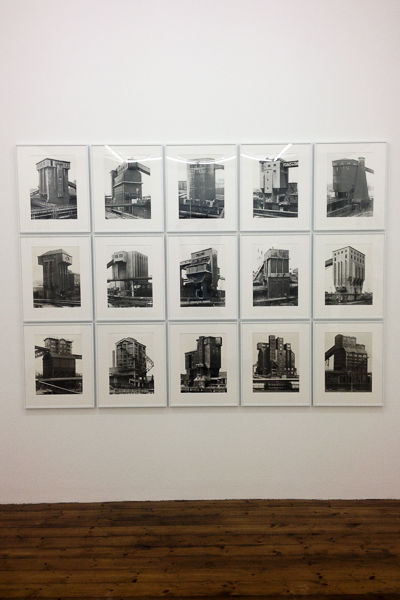
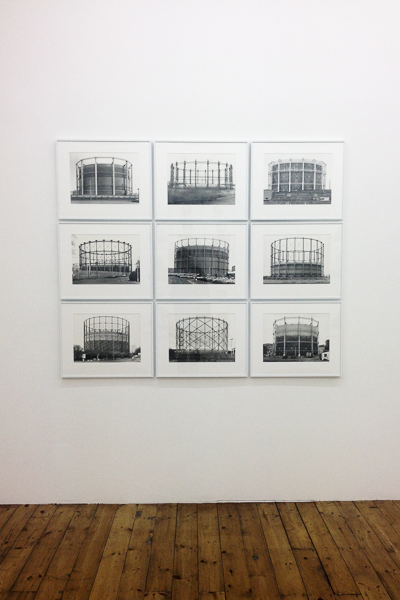
bernt & hilla becher

water towers

water towers

coal bunkers

coal bunkers

gasometers

gasometers

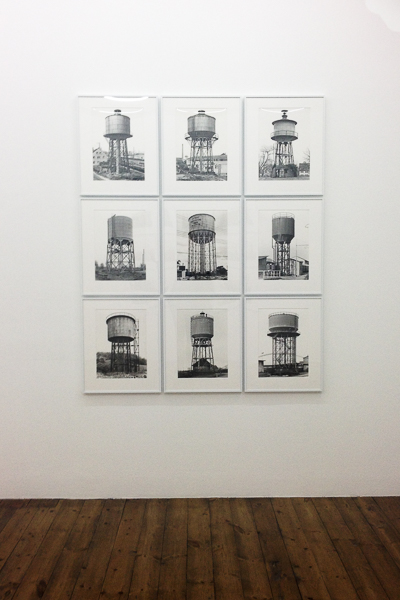
I caught the small exhibition (4 groups of 9 pictures ­ Cooling Towers, Water Towers, Gasometers and Commercial Facades ­ 1 of 15 pictures ­ Coal Bunkers ­ and some larger single images in a room off to one side) at the Spruth Mather gallery in Mayfair. It was good, free, but only ran until Saturday 4th October.

All the groupings were of large prints tightly grouped in plain white frames. The gallery was quiet ­I was the only person there most of the time ­ so you could get close, peer in at the printing and spend enough time with the pictures to start to see more than just the repetitions. So what did I see…

Firstly, I marvelled at the ability of the eye to anthropomorphise – so many of the coal bunkers looked like insects or other small scuttley animals ­- but having got over that, I realised I was enjoying both the printing – so many different greys! ­- and how the way the Bechers used the tilt facility on the large format camera they used for their series to keep verticals vertical rendered everything slightly strange ­- verticals seen from below sometimes seems to converge at the bottom rather than in a “normal” vanishing point at the top ­- but in a much more subtle way than the perspective compensation stuff in Lightroom does. The flat white of the skies would have simply been blown highlights in digital colour, but here it ­- and the way the details in the background behind the industrial subject tends to overexposure ­- foregrounds the shape of the subject. Whether this was a result of the exposure on its own, good printing technique or a combination of the two, the effect was a good one, and one that it would be fun to play with. Individually some of the pictures were beautiful and -­ unlike much art photography -­ I’d happily hang them on the wall of my house; taken in their typed groups they were fascinating, illustrations of how you can build up series over time. I think the ones I liked best were the ones that most chime with my experience ­- the gasometers and the water towers.

Certainly there is stuff I can apply to pictures I make myself. The idea of taking similarly composed pictures of the same type of structure could easily be applied to the modernist coastal defences in Orkney; then there’s the German Atlantic Wall along the French coast; from behind, looking out to sea would be one angle, what would be the other? There are deflated gasometers all around me in the east end of London and to the east of Glasgow as you drive out on the M8 there are water towers, which look nothing like the “shuttlecock” water tower on the way in from Stansted. In the attic I have a Graflex Press Camera that I really should use to overcome my fears of bellows and recipricocity and tilts and shifts and have a proper play with. Maybe I could even start processing film again. Maybe I could work out how to get 5×4 sheets of colour slide film to a lab somewhere that will still do large format transparencies. I just need to find the time.

Meanwhile, I must get a frame for the poster of some of the blast furnaces that had its price massively reduced in the Tate Modern sale and get it up on a wall…

elements of design # 8 – rhythm and pattern

Produce at least 2 photographs, one should convey rhythm, the other pattern. Remember that that in rhythm there needs to be a sequence in the picture so that the eye will follow a direction and experience an optical beat. For the pattern photograph, be careful with the framing […] so that the eye can imagine it continuing well beyond it. – AoP Coursebook

Continue reading

assignment # 2 – elements of design: pictures + commentry

Produce 10-15 photographs, all of a similar subject…

Flotta – Friday 1st August 2014

This slideshow requires JavaScript.


…between them they will show the following effects:

1: single point dominating the compostion

1: A Single Point

1: A Single Point

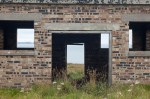
I thought long and hard about using one of the shots of the wind turbine, with its nacelle as the point, but in the end decided that a: the square view through the window and the doorway of this small brick hut (a sentry hut?) was “pointy” enough and b: that this was a much stronger photo than any of the turbine pictures. I particularly like the way moving your eyes over its surface  generates a strong sense of refocussing (as discussed in part 4 of Shore’s The Nature of Photographs) and the way the various horizontal and vertical lines in the picture reinforce the idea of the frame. The point possibly becomes a punctum, leaving us with a picture about pictures hung on (or here, in) a wall, with the almost central positioning of the point achieving a sense of uneasy stillness which works nicely with the flatness of the view.

2: two points

2: Two Points

2: Two Points

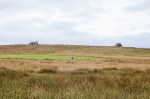
Two water tower supports, out towards Stangar Head. I think these qualify as points because of the way the crumbling concrete contrasts with the softness of the land and the lack of any obvious focal point out towards the horizon. This is probably a bit soft, when viewed at print size, a warning not to use a heavy 35-70mm zoom handheld with a shutter speed of 1/80th sec. The framing of this is key: I spent a reasonable amount of time with the camera, judging how close to the edge the two structures needed to be to achieve some sense of balance; I then carried on this process cropping a bit more off the the sides and bottom of the image in Lightroom. I hope your eyes travel along the horizon from the larger tower to the smaller one, and then back again…


a combination of vertical and horizontal lines

3: Vertical and Horizontal Lines

3: Vertical and Horizontal Lines

A natural triptych which – like 1 – creates a very strong sense of planes. Taken inside a searchlight emplacement (the light would have split into 3 strong beams as it passed through the vertical slits) I used the camera’s flash throttled back to minimum intensity to get some sense of texture on the inside wall helped by the black staining, which is presumably carbon deposited by the arc-ing rods that made the beam of the searchlight. It was hard getting the colour temperature right here, something that wasn’t made easier by the chromatic aberration visible down the verticals of the slits, that I only noticed when I got the second version of the print back. I’ve corrected it on the file uploaded here, and will get a new print made when I get the prints made for assignment 3.

several points in a deliberate shape

4: Several Points in a Deliberate Shape

4: Several Points in a Deliberate Shape

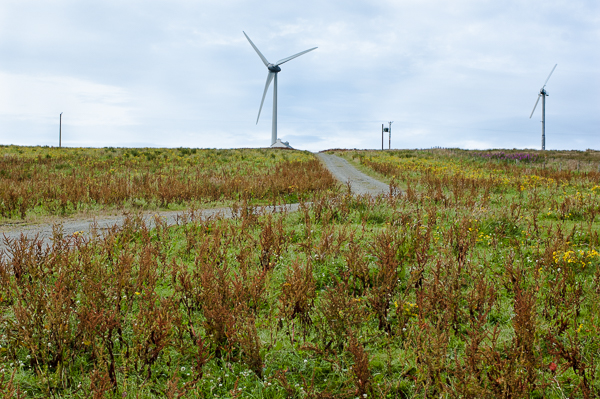
Two triangles combine to make a quadrilateral tilted away from the viewer like a ceiling over the ludicrously busy field. Your eye either moves round the edge of the shape, or zigzags up from the pole on the right, to the windmill, down to the power post and back up to the other smaller windmill. The slight a-symmetry of the distances off to the left and right edges of the shape make it more interesting than if I had moved off to the left, when I would have lost the way that the field above the road and the sky area locks jigsaw-like into the foreground bit of field with its run-to-seed docks and yellow flowers.

distinct, even if irregular, shapes

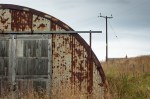
I took advantage of the 10-15 picture scope for this assignment to add all three of these – a building of unknown purpose at Stangar head, the inside of the buried nissen hut that acted as the magazine for Buchanan Battery and a recycled nissen hut spotted on my way back to catch the ferry. I think compositionally the three work as a sequence, with the centrally placed doors of 5 and 6 creating a similarity with the curve of the nissen hut in 7 echoing the corrugated ribs in the roof of 6.

5 and 6 are fine (and I like the green object in 6 – a Heineken can? – in the lit part of the spill of earth into the hut, wishing the coke bottle in deep shadow over to the left was equally lit) but I’m particularly happy with 7 where planes merge into one another making shapes out of things that would have simply seemed unrelated if I hadn’t moved left and right, back and fore til they lined up and worked as a 2D arrangement…

curves

8: Curves

8: Curves

Here, I think the viewer’s eyes starts at the top left of the frame and follows the zig and the zag of the road down to the bottom right; the fence post directs the eye up to the cottage and then you track up the gentler curve of the horizon back to the top left. And then you do it again. It would be slightly better if i’d taken half a step to my left, lining up the ruined cottage’s chimney with the fencing stab, I think, but I can live with it as it is. Definitely among my favourites out of the pictures  in the assignment.

diagonals

9: Diagonals

9: Diagonals

I spotted the playpark as I walked through the village and realised it was perfect for doing something that collapsed the many planes formed by the various bits of equipment into something much flatter. It was then huge fun to move left and right, step back and take a half step forward again, squat down, stand up, lean and lean back before taking each of the 3 pictures I took here. This is the one that creates the nicest chaos of diagonals, I think.

The only bit that I feel unhappy with is the very top where I can’t quite work out where the exact point to cut off the confluence of the near poles should be. As a result, it’s an ‘almost’ rather than a ‘definitely’. Getting it right would involve going back though, and I won’t be able to do that until next year now.

at least two kinds of implied triangle

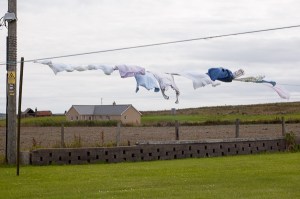
Another group of 3 to take advantage of the 10-15 limit, as 10 manages to get the asked-for two with the obvious vanishing point of the road tailing off towards the horizon, and the inverted triangle formed by the two cottages on either side of the road and the inverted Stop! Children sign painted on the road. 11 was included as the first thing I thought when I noticed the two cottages and the bloke in a red caghoul, fixing a fence was “triangle!” – it proved a lot harder to get the red of the caghoul light enough and red enough (and the landscape light enough for it to show up strongly) than I thought it would. 12 is there because i like the way that the bank opening up to the concrete shelter on the right seems to lack any sense of depth, while pointing the way to a vanishing point somewhere off to the left. Also, it rhymes beautifully with the triangle formed by the washing lines in…

rhythm
13: Rhythm

13: Rhythm

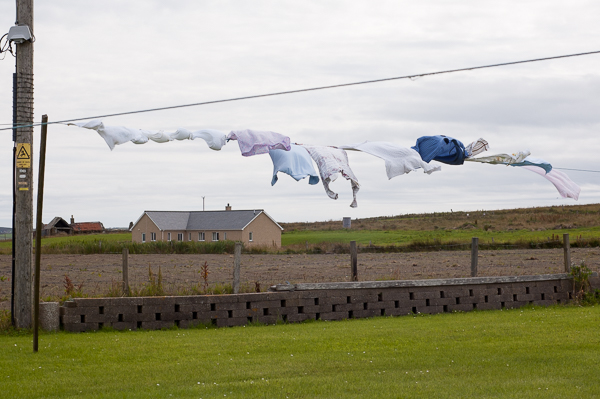
…this one! Here I took several other shots, trying to get a fully left to right waveform from the clothes on the line; this was the one that worked best. Also, the way the gaps in the breezeblock wall and the fencing stabs below the washing move left to right in some sort of counterpoint helps the rhythmic feel here. the way the washing pole seems to bend into the picture helps too.

pattern

14: Pattern

14: Pattern

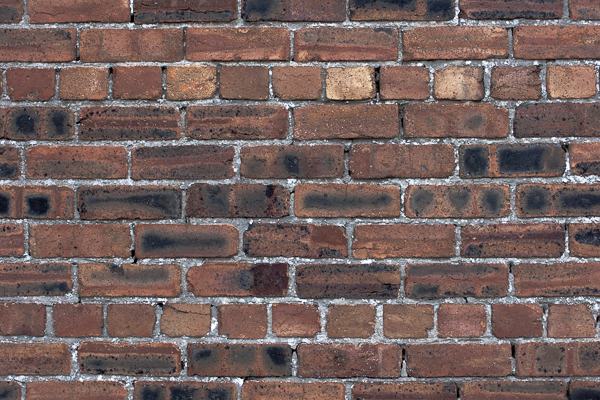
As I said elsewhere, brick isn’t really a particularly Orcadian building material and is only really found in the wartime buildings that dot the landscape. I wish I’d been able to find a more imaginative pattern somewhere, but I didn’t, so here’s a section of the wall of the Fleet Communications Centre. After 70 odd years, at least the pointing is holding up…


Lastly, I confess that I have deviated from the order these are given in the Assignment Brief, as the images seem to flow better this way: eg the final implied triangle matches the way the washing lines fill the upper half of rhythm; the first four pictures go obviously one, two, three, four; diagonals goes quite naturally to the first implied triangle, and not just because they’re the only ones in portrait format.

At any rate, if I were to hang the prints on a wall, this is the order I would like you to walk past them.

elements of design # 7 – real and implied triangles

1: Real Triangles –

Find a Subject which is Triangular

A subject which is itself triangular

A subject which is itself triangular

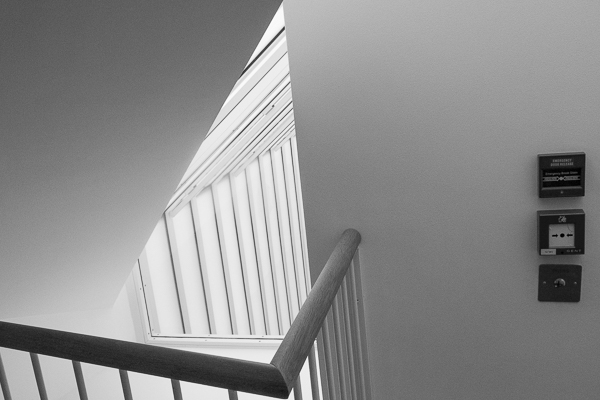
There are loads of triangle in the left half of this – shot upstairs in the Pier Arts Centre in Stromness, but the best two are the one made by the vertical line of the wall and the slope of the roof and the the one made outside the banister. Continue reading

elements of design # 6 – implied lines

There’s nothing to add to what I’ve seen in other people’s logs about the two pictures (the bullfighter and the circling horses) at the start of the exercise (Part 1), so straight on to three examples of my own (Part 2):

Continue reading

assignment 2 – contact sheets & general notes

1: Orkney is notoriously flat; Flotta is even flatter. (Ha!)
A friend from University whose dad worked for years making documentaries in Scotland told me that cameramen used to refer to an “Orkney Shot”; a shot framed so that something – anything – acted as a stop on one or other sides of the frame, to stop the eye just sliding through and out. This is maybe a bit unfair on Orkney, but once you’re out of the towns, there is an awful lot of sky over quite flat horizons and – if you want to take a picture of some foreground thing, it is likely to have sky behind it. My first thought almost all the time was to make sure that the sky didn’t simply blow out, and in processing the pictures back at my sister’s house, to keep some interest in the overcast sky, while raising the general lightness of the the land and the objects on it. Also, on an overcast day, there isn’t a lot of contrast around as the sky acts as an enormous soft box, spilling diffused light over everything; black and white was not going to work for my Flotta pictures and anyway, the muted range of August colours is quite attractive. All the assignment pictures therefore remain in colour.

2: Generally, I took fewer photographs of each thing than I did during assignment 1. To an extent, I think this was a result of limited time on the island concentrating my mind somewhat, but it also marks less of a tendency to think that tiny little things – marginal reframes, a slight shift of my weight – will result in a profoundly better photograph; rather the pictures where there a many shots were taken because of something I was consciously trying different things with: the windmill shots were repeated to try and vary the timing of the blades in relation to the corners of the frame, and the pictures inside the searchlight emplacement (# 3 in the final selection) were trying different flash settings, trying to get a still dark inside, but not black balance between inside and outside and a couple of different lenses. On the whole, i think I was much more consciously taking pictures, rather than just concentrating on what was in the frame. It also felt more like fun at times. I hope this shows in the pictures.

3: Buildings in Orkney were traditionally made from stone, and now tend to be made from breeze-blocks and then harled. The wartime installations used that most uncharacteristic material brick, with some parts made from reinforced concrete. There were a lot of corrugated iron nissen huts too. Quite a few nissen huts are still in use, and the  brick buildings have lasted well despite wind and rain and neglect. The reinforced concrete is starting to go though (and signs are going up saying, don’t enter the buildings because they’re dangerous) but you can still see that the batteries were designed by people who’d recently qualified as architects and were throwing their dreams of Bauhaus into the war effort.

4: It’s remarkably easy to lose track of time when you’re walking and taking pictures, and thinking and looking. It’s easy to see fro the contacts that the amount of time spent getting to Buchanan Battery far outweighed the time I had to get back to the ferry (even if you allow for some of sheet 1’s pictures being taken on the boat back to the mainland). While taking the pictures on sheet 6, I had a late lunch; sheet 7 was all taken as I walked, picking up my pace as time slipped by. I still managing to stop to take some, but not that many pictures, although a close look shows that they’re much more rushed than the earlier ones, and there were glaring things I missed, like the spot of rain on the lens spoiling some farms set among rather nice overhead cable geometry). The two shots of the ferry approaching the slip on sheet 7, show how close I came to missing it. Really, I should know better…