Category Archives: Research and Reflection

bernt & hilla becher

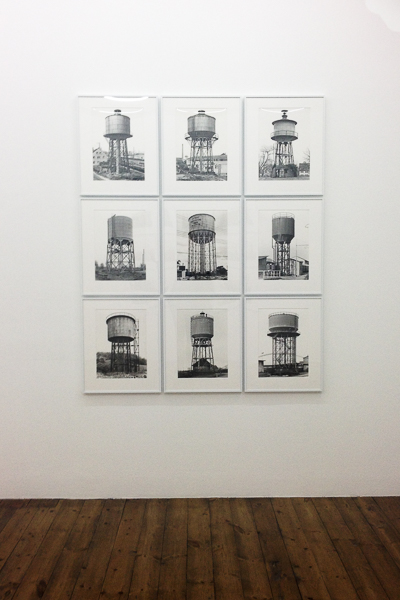
water towers

water towers

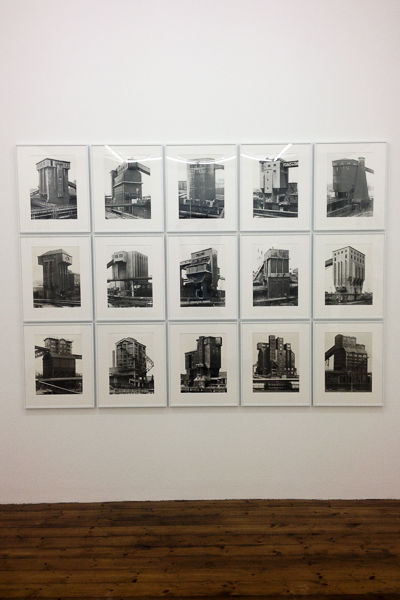
coal bunkers
coal bunkers

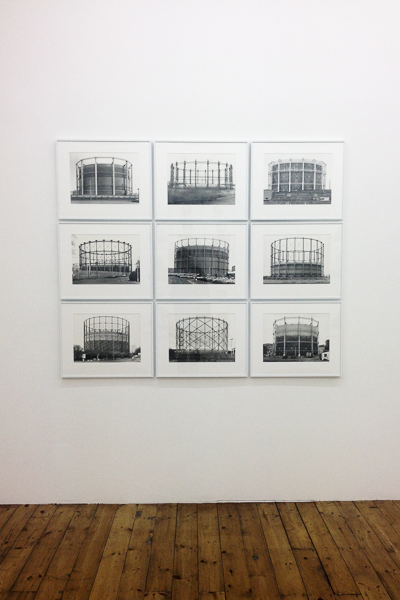
gasometers

gasometers

I caught the small exhibition (4 groups of 9 pictures ­ Cooling Towers, Water Towers, Gasometers and Commercial Facades ­ 1 of 15 pictures ­ Coal Bunkers ­ and some larger single images in a room off to one side) at the Spruth Mather gallery in Mayfair. It was good, free, but only ran until Saturday 4th October.

All the groupings were of large prints tightly grouped in plain white frames. The gallery was quiet ­I was the only person there most of the time ­ so you could get close, peer in at the printing and spend enough time with the pictures to start to see more than just the repetitions. So what did I see…

Firstly, I marvelled at the ability of the eye to anthropomorphise – so many of the coal bunkers looked like insects or other small scuttley animals ­- but having got over that, I realised I was enjoying both the printing – so many different greys! ­- and how the way the Bechers used the tilt facility on the large format camera they used for their series to keep verticals vertical rendered everything slightly strange ­- verticals seen from below sometimes seems to converge at the bottom rather than in a “normal” vanishing point at the top ­- but in a much more subtle way than the perspective compensation stuff in Lightroom does. The flat white of the skies would have simply been blown highlights in digital colour, but here it ­- and the way the details in the background behind the industrial subject tends to overexposure ­- foregrounds the shape of the subject. Whether this was a result of the exposure on its own, good printing technique or a combination of the two, the effect was a good one, and one that it would be fun to play with. Individually some of the pictures were beautiful and -­ unlike much art photography -­ I’d happily hang them on the wall of my house; taken in their typed groups they were fascinating, illustrations of how you can build up series over time. I think the ones I liked best were the ones that most chime with my experience ­- the gasometers and the water towers.

Certainly there is stuff I can apply to pictures I make myself. The idea of taking similarly composed pictures of the same type of structure could easily be applied to the modernist coastal defences in Orkney; then there’s the German Atlantic Wall along the French coast; from behind, looking out to sea would be one angle, what would be the other? There are deflated gasometers all around me in the east end of London and to the east of Glasgow as you drive out on the M8 there are water towers, which look nothing like the “shuttlecock” water tower on the way in from Stansted. In the attic I have a Graflex Press Camera that I really should use to overcome my fears of bellows and recipricocity and tilts and shifts and have a proper play with. Maybe I could even start processing film again. Maybe I could work out how to get 5×4 sheets of colour slide film to a lab somewhere that will still do large format transparencies. I just need to find the time.

Meanwhile, I must get a frame for the poster of some of the blast furnaces that had its price massively reduced in the Tate Modern sale and get it up on a wall…
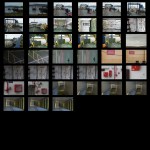
assignment 2 – contact sheets & general notes

1: Orkney is notoriously flat; Flotta is even flatter. (Ha!)
A friend from University whose dad worked for years making documentaries in Scotland told me that cameramen used to refer to an “Orkney Shot”; a shot framed so that something – anything – acted as a stop on one or other sides of the frame, to stop the eye just sliding through and out. This is maybe a bit unfair on Orkney, but once you’re out of the towns, there is an awful lot of sky over quite flat horizons and – if you want to take a picture of some foreground thing, it is likely to have sky behind it. My first thought almost all the time was to make sure that the sky didn’t simply blow out, and in processing the pictures back at my sister’s house, to keep some interest in the overcast sky, while raising the general lightness of the the land and the objects on it. Also, on an overcast day, there isn’t a lot of contrast around as the sky acts as an enormous soft box, spilling diffused light over everything; black and white was not going to work for my Flotta pictures and anyway, the muted range of August colours is quite attractive. All the assignment pictures therefore remain in colour.

2: Generally, I took fewer photographs of each thing than I did during assignment 1. To an extent, I think this was a result of limited time on the island concentrating my mind somewhat, but it also marks less of a tendency to think that tiny little things – marginal reframes, a slight shift of my weight – will result in a profoundly better photograph; rather the pictures where there a many shots were taken because of something I was consciously trying different things with: the windmill shots were repeated to try and vary the timing of the blades in relation to the corners of the frame, and the pictures inside the searchlight emplacement (# 3 in the final selection) were trying different flash settings, trying to get a still dark inside, but not black balance between inside and outside and a couple of different lenses. On the whole, i think I was much more consciously taking pictures, rather than just concentrating on what was in the frame. It also felt more like fun at times. I hope this shows in the pictures.

3: Buildings in Orkney were traditionally made from stone, and now tend to be made from breeze-blocks and then harled. The wartime installations used that most uncharacteristic material brick, with some parts made from reinforced concrete. There were a lot of corrugated iron nissen huts too. Quite a few nissen huts are still in use, and the  brick buildings have lasted well despite wind and rain and neglect. The reinforced concrete is starting to go though (and signs are going up saying, don’t enter the buildings because they’re dangerous) but you can still see that the batteries were designed by people who’d recently qualified as architects and were throwing their dreams of Bauhaus into the war effort.

4: It’s remarkably easy to lose track of time when you’re walking and taking pictures, and thinking and looking. It’s easy to see fro the contacts that the amount of time spent getting to Buchanan Battery far outweighed the time I had to get back to the ferry (even if you allow for some of sheet 1’s pictures being taken on the boat back to the mainland). While taking the pictures on sheet 6, I had a late lunch; sheet 7 was all taken as I walked, picking up my pace as time slipped by. I still managing to stop to take some, but not that many pictures, although a close look shows that they’re much more rushed than the earlier ones, and there were glaring things I missed, like the spot of rain on the lens spoiling some farms set among rather nice overhead cable geometry). The two shots of the ferry approaching the slip on sheet 7, show how close I came to missing it. Really, I should know better…


malevich – at the tate

Alice, my daughter, aged 18 months, woke up disgustingly early on Sunday (4.30 am) and my partner, Fiona, very nicely looked after her til a more reasonable breakfast time. In order to give Fiona a chance to go back to bed and have a sleep without any interruptions, Alice and I went out and headed down to Leyton and the central line and St Pauls, then across the river to Tate Modern. Alice likes running around in the wide open spaces of the turbine hall; I was hoping to get a first look at the Malevich Retrospective. Neither of us was disappointed… Continue reading

reading – during part 1 of the course

I have read (and re-read) the first two chapters of both Photography: a Critical Introduction (ed Wells; Routledge, 4th Edition 2009) and The Photograph (Clarke; OUP, 1997) as I have gone back and forth, to and from work, while I have been working through Part 1 of The Art of Photography. Both books cover similar things here – photography itself and how it developed over the first 150 or so years of its existance, the relationship between pictures and the things they depict, what makes a photograph a photograph and what difference do all these things make to the way we think while looking at pictures.

Alongside this, I have also read bits of Understanding a Photograph (John Berger; Penguin, 2013) and The Nature of Photographs (Stephen Shore; Phaidon, 2010); the combination of all these has, I think combined to change the ways I view other people’s photographs, although I don’t think it has fed into my own work in any tangible way yet…

…or so I wrote in the middle of July, while I was waiting for the feedback on my first assignment. I intended to come back and expand on this, but I didn’t.

Foolish, forgetful Simon! Continue reading

deutsche börse photography prize 2014

photographers' gallery, london

5th floor, photographers’ gallery, london

Last week I made my second and third visits to the Deutsche Börse Photography Prize showing at the Photographers’ Gallery. I was able to do multiple visits (my first had been the week before) because the gallery is about 10 minutes walk from my work, so a quick lunchtime visit is easily made. This is perfect when the exhibition is free and you can layer impression upon impression over the show’s run, which ended on Sunday.

4 artists were in contention for the prize, 2 on each of the top two floors the gallery.  On the fifth floor were photos by Lorna Simpson and Richard Mosse; on the fourth, photos by Jochen Lempert and Alberto Garcia Alix.

Mosse won overall, so I will start there with him:

Richard Mosse – The Enclave:

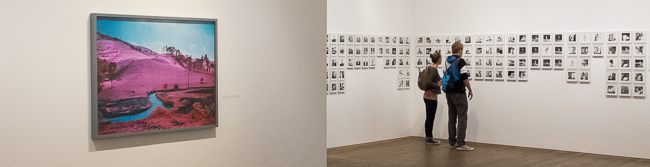
Photos taken using infrared stock (the effect of which can be seen on the header, on the left) of landscapes and people on the border between The Democratic Republic of Congo and Rwanda. Various groups have been fighting over this territory since the end of the Rwandan genocide, a brutal fact which contrasts strongly with the strange beauty of the large infrared prints where the green of foliage is shifted into a brilliant magenta and water and the sky are turquoise as lapis luzali. For me, the aestheticisation of the warzone certainly supplied a punctum to add distance between me and what was portrayed, the effect being to render the scenes strange and not of this world, creating a space where I could think about “war” and “africa”; but they also echoed psychedelic and prog rock album sleeves, which at least partially collapsed the political intent. That said, they were lovely to look at – and very large indeed – but I think the looking was primary, with the connotations of war – explicitly stated in the captions – coming a poor second, even in pictures of people in colour-shifted red-brown uniforms with guns; in some ways they seemed as created as last years’ fictional series telling the story of a 1960s Zambian space programme by Christina de Middel. But they were ravishing to look at.

Lorna Simpson – Summer ’57/Summer ’09:

A huge array of 5×5 black and white pictures (to the right in the header), shot, by the look of things, on a twin lens reflex. Some were a publicity portfolio taken in the 50’s and bought by Simpson from ebay; some were Simpson’s recreations of them, with her as a model in similar poses and locations. This was fascinating to look at, trying to work out which were original and which were the copies, although this was made easier (I think) by the differences in finish of the two sets of pictures. I’m not sure how much they comment on issues of race in the USA, but the interest to me centred around how the 50’s model seemed utterly comfortable with the cheesecake poses she was striking while Simpson achieved a degree of separation between who she was and what she was doing; in the sense that the early pictures were natural and so hugely denotive, the recreations managed to call the whole set’s authenticity into question. I probably spent more time looking at these, with my mind whirring, than any of the others apart from:

Alberto Garcia Alix – Selfportrait:

Like Chris Killip’s nominated work for last year’s prize, these pictures of Garcia Alix and his circle taken between the late 70s and a couple of years ago seemed quite old fashioned – black and white, documentary images shot over a period of time in a specific location. Also the subject matter – the photographer and his friends shoot up, get tattoos and get progressively more leathery and drawn over time – doesn’t seem particularly groundbreaking (I was thinking of Nan Goldin and Larry Clark as comparisons) but over the three lunchtimes – during which time I managed to see the whole of the 37 minute film that linked sequences of stills with ghostly black and white video footage of (I think) Beijing – I found I was more and more impressed by the way he seemed to view his move from handsome 22 year-old to Spanish-Keith-Richard-alike with distance and a lack of editing out the unpleasant. Also, like Simpson, he seemed to be dealing with poses from an earlier age – they were insider pictures of the other, but an other that was aware of its antecedents. Another example of photographs plus time equaling an increasing degree of meaning.

Jochen Lempert – Jochen Lempert:

The exhibition leaflet said:

Originally trained as a biologist, Lempert has been using photography since the early 1990s to study humans and the natural world. With an eye for subtle contrasts within subject matter – moss growing over a metal fence; a butterfly and its shadow on the grey concrete of the street – his use of repetition, pattern and abstraction creates connections between otherwise distinct subjects. His approach is scientific and poetic as well as humorous.

But this was the one I didn’t get. I tried. And I tried again. And again. But I did not get it. My fault, not his, I’m sure…

More generally, it was interesting that everyone was using film, albeit in very different ways, making it quite a traditional set of nominees. All four in some way created some distance between subject matter and the pictures themselves (although, for me, Lempert created so much distance, I switched off). Mosse’s pictures won, but – aside for being glad that I saw them blown up to such huge proportions – I think I could have got the idea from reading about them; it was Garcia-Alix and Simpson’s pictures that I found myself going back to, analysing the performances, the distance between the old poses and the later recreations and enjoying the experience. Not sure how I would apply any of this to my work. But I’ll keep on thinking.


Panel Discussion: Photography Today – National Portrait Gallery, 05-vi-14

From my photography day-book...

From my photography day-book…

Mark Durden, author of Phaidon’s Photography Today (2014), a survey of photography as art from the 1960s to the present, is joined by the Guardian’s photography writer Sean O’Hagan* and photographer Sarah Jones to discuss themes of the self, the face and the body in photographic works by modern masters such as Diane Arbus, William Eggleston, Nan Goldin and James Nachtwey. In association with Phaidon. Continue reading

a start at reading

Yesterday, two packets from Amazon landed on my desk at work. They contained:

  • The Photographer’s Eye – Michael Freeman (ILEX, 2007)
  • Photography, A Critical Introduction, 4th Edition – ed. Liz Wells (Routledge, 2009)
  • Behind the Image Research In Photography – Anna Fox & Natasha Caruana (AVA Academia, 2012)

After work, I stopped off at The King and Queen for a pint and to have a first look at the new books, having enough time to read the introductions before I went on to the tube and home. Continue reading

Jane Bown – Looking For Light

You’ll know at least one photograph by Jane Bown; she took the picture of Samuel Beckett staring into the camera like an eagle in a white knitted polo neck. And it’s in the small exhibition of portraits taken by her for The Observer at the Guardian Offices by Kings Cross Station marking the release of a film documentary about her. Continue reading

A toe dipped into the ocean of criticism…

I started at the first suggested stop on my tutor’s list of places to go for thoughts on the current state of photographic theory, The Ethics of Street Photography – Joerg Colberg 03/04/2013 (Conscientious Extended) about whether Garry Winogrand’s profession that he never asked permission to photograph people was ethically ok (Colberg felt that no, really it wasn’t) Continue reading