Alice, my daughter, aged 18 months, woke up disgustingly early on Sunday (4.30 am) and my partner, Fiona, very nicely looked after her til a more reasonable breakfast time. In order to give Fiona a chance to go back to bed and have a sleep without any interruptions, Alice and I went out and headed down to Leyton and the central line and St Pauls, then across the river to Tate Modern. Alice likes running around in the wide open spaces of the turbine hall; I was hoping to get a first look at the Malevich Retrospective. Neither of us was disappointed… Continue reading
assignment 2 – background
In the feedback for Assignment 1 Dave, my tutor, suggested that for the next one, I limit myself to an area one kilometre square, to try and establish more thematic continuity between pictures than I had managed in the first assignment. Fairly early on during part two, I had identified that I should be able to get all the elements needed for the pictures in Jubilee Park, Leyton and had even begun to take some pictures as ‘sketches’ for the early point pictures.
- single point (abandoned)
- two points (abandoned)
Then I went off on holiday to Orkney.
At this point, I had pretty much all the photographs I needed for the first 5 exercises of Elements of Design, and some for the remaining three exercises. During the first week in Orkney, I got quite a few of the others. While I did manage some sorting and editing of pictures, I had also intended to spend some of my time writing up the exercises and the reading I’d been doing in my log, but of course time in the evenings seemed better spent with relatives or drinking beer with friends or just staring into space. Which is as it should be on a holiday, really.
Then the one large chunk of time I was going to get to spend on my own (abandoning children, partner and all for a whole day) came round with a forecast of clear weather. I decided to go to take a ferry to one of the smaller islands and spend the day exploring and taking pictures. The idea that I could take the assignment pictures there began to form in my head. I wrote down the photo requirements for the assignment in my day book, charged batteries and made sandwiches, and set my alarm to allow me to catch an early ferry.
The island I’d decided to visit was Flotta…
The word Flotta means “flat island” in old norse and at its highest point, the island is only 59m above sea level. From the trig point you get a very good idea of Scapa Flow laid out around you: there’s the two main towns on the mainland – Kirkwall and Stromness – and also have a great view southwest into Longhope bay and of the various even smaller islands scattered to the north and the south.
The mouth of Longhope bay is guarded by two martello towers built to protect convoys before they set out for Canada during the American war of 1812. During the two world wars, you’d have seen the fleet at anchor in Scapa Flow, and also the boom defences (big, heavy steel nets, hung from floats) used to close off the two main ways in and out of the anchorage. There were gun batteries built on the east and south sides of the island and the fleet control centre stood at the south-east tip. There were anti aircraft batteries and searchlights and barrage balloons. It was a busy place during the war, and there was a large (1800 seat) cinema and concert hall, over by the two piers on the west side of the island. Many of these buildings and emplacements are still there, and in a fairly good state.
Now, the boats anchored in Scapa Flow are likely to be tankers, waiting to be loaded with crude from the Flotta Oil Terminal, whose rows of storage tanks are fed by a pipeline from the Forties field in the North Sea.
These waves of activity – war, war, oil – have fed into Orkney’s economy topping up the islands’ finances way beyond the level that it could have reached relying on agriculture alone. Flotta has been at the centre of all this, as it is at the centre of Scapa Flow. It’s population is low (under 80, I think, and most of them retired), and the primary school closed a couple of years ago when all the children on the island had gone to the secondary school in Kirkwall. Most of the oil workers commute out from the mainland, but the island isn’t completely dead. There’s still a post office; land is farmed; boats come and go.
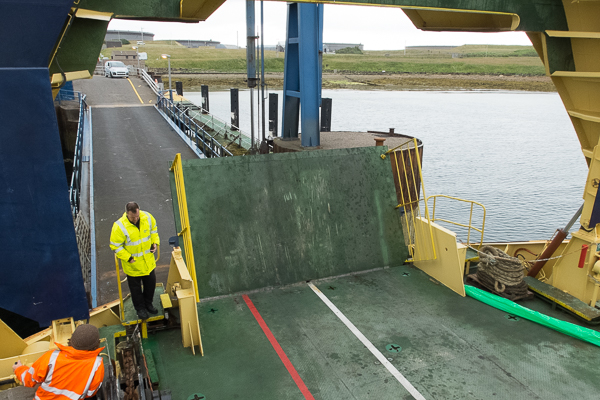
On Friday 1st August this year, I was heading out from Lyness on one of them, with 7 hours to explore and take pictures before the last boat back in the afternoon.
The ferry puts you ashore on a slip in the middle of the western side of the island and I had decided to walk round the southerly loop, only going out along the thin peninsular to the north if I had time before the ferry returned to take me away in the afternoon. On my way, I intended to visit as many of the gun batteries on the east side (overlooking Hoxa Sound towards South Ronaldsay) and the south side (overlooking Switha Sound towards Hoy) as I could. I also wanted to take in the Fleet Direction Centre at Stangar at the south east point of the island. Then I’d follow the coast back round to the slip, passing the airstrip that had been built for the construction of the oil terminal in the 70s and the cinema on my way.
As always, I was wildly optimistic (or easily distracted) and after detours to the wind turbine by the trig point, off to investigate a nissen hut near the village and other bits of general looking at stuff and thinking about things and taking pictures and that, I only really managed to take in the first battery (Buchanan), the signal station (where I had my lunch) and the airstrip. It was enough – just – to get the pictures for the assignment, but another hour or so would have been nice…
reading – during part 1 of the course
I have read (and re-read) the first two chapters of both Photography: a Critical Introduction (ed Wells; Routledge, 4th Edition 2009) and The Photograph (Clarke; OUP, 1997) as I have gone back and forth, to and from work, while I have been working through Part 1 of The Art of Photography. Both books cover similar things here – photography itself and how it developed over the first 150 or so years of its existance, the relationship between pictures and the things they depict, what makes a photograph a photograph and what difference do all these things make to the way we think while looking at pictures.
Alongside this, I have also read bits of Understanding a Photograph (John Berger; Penguin, 2013) and The Nature of Photographs (Stephen Shore; Phaidon, 2010); the combination of all these has, I think combined to change the ways I view other people’s photographs, although I don’t think it has fed into my own work in any tangible way yet…
…or so I wrote in the middle of July, while I was waiting for the feedback on my first assignment. I intended to come back and expand on this, but I didn’t.
Foolish, forgetful Simon! Continue reading
elements of design # 5 – curved lines
For this exercise, look for and take four photographs using curves to emphasise movement and direction.
– AoP Coursebook
elements of design # 4 – diagonal lines
To add to your set of examples of horizontal and vertical lines, now take four photographs which use diagonals strongly.
– AoP Coursebook
elements of design # 3 – horizontal and vertical lines
Produce 4 examples of horizontal and 4 of vertical lines. Avoid repeating the way in which a line appears. The most successful will be those in which the line is the first thing a viewer would notice.
– AoP Coursebook
elements of design # 2 – multiple points
REPORT ON MANTLEPIECES
As a first test of your powers of observation, try the following:-
Write down in order from left to right, all the objects on your mantlepiece, mentioning what is in the middle.
Then make lists for mantlepieces in other people’s houses, giving in each case a few details about the people concerned, whether they are old, middle-aged or young, whether they are well off or otherwise, What class (roughly) they belong to. Send these lists in.
If possible, also take photographs of mantlepieces.
Directive to New Observers – Mass Observation c.1937
Reading Picturing Ourselves (p 93, Wells), I remembered the note I made of the Directive to New Observers at the Mass Observation exhibition at the Photographers’ Gallery (Aug-Sep, 2013) at much the same time as I found myself identifying with Humphrey Spender’s description of himself on page 94, as an outsider exploiting others while picturing them. This exercise – create a still life and at the same time create a network of points – seemed a good way to combine that identification with an attempt to start characterising who the me who takes photographs is. Also, the amount of stuff from holidays, work trips etc etc that had silted up on the mantlepiece needed dusting and thinning out. I decided to clear everything off and start again, building up a still life from some of the things that were there as I went.
elements of design # 1 – positioning a point
3 pictures designed around points
For the first I’m taking the sheep’s face; the second is the ship; the third is the crumpled union-jack bunting… Continue reading
starting part two – elements of design
Right. Back from holiday in Orkney, with lots of photos taken. Lots of reading done too, and a couple of exhibitions under my belt. Raring to go again in fact. Continue reading
the frame # 9 – cropping and extending
Again – like swapping the camera blithely through ninety degrees – I think I have been cropping photographs fairly consistently during this part of the course, making a banner header for most of the exercise posts. I definitely like panoramas, on screen at least – I don’t think I often get any thing printed that isn’t fairly close to either square or a standard 3:2 frame…
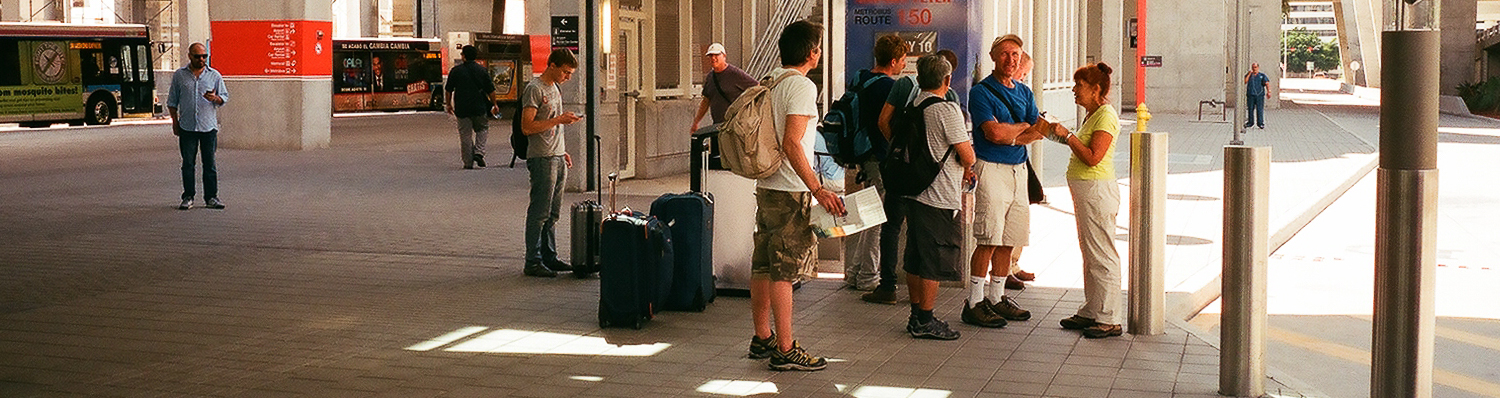
Generally, any hesitations I have over changing the frame from what was shot, come from reducing my ability to view (either as prints or on screen) large versions of the resulting pictures. The reason can be seen in the Miami Airport Bus Station picture, which was taken from a scan made by Snappy Snaps at the same time as they made me a set of 6″ x 4″ prints.
Looking closely at the original or not that closely at the crops, shows how low the resolution was for this. Also, while I don’t seem to mind isolating a small section of a negative, I am definitely reluctant to alter the aspect ratio. I’m not sure why, but I suspect that it has something to do with liking the regular conformity of a series of pictures, as much as anything. That said, there seems something horribly random about composing a picture through a viewfinder and then changing its shape radically later.
This probably ties in with a reluctance to desaturate digital pictures to make black and white images and the fact that I own one panoramic camera with a swing lens and quite a few medium format cameras that take square pictures. I also suspect that this is something I need to confront and get over.
Anyway, here are a couple of cropped pictures with comments inline with them when viewed as a slideshow:
1 – Miami Airport Bus Station, April 2014
- Original
- Crop 1: landscape
- Crop 2: Portrait
- Crop 3 – panorama
2 – Alice – Turbine Hall, Tate Modern, May 2014
- Original frame
- Portrait Crop
- Panoramic Crop
3: All Souls’ Church from Oxford Circus, June 2014
The idea of extending pictures is one that interests me. This (shot at the same time as I was doing Exercise # 5) is an attempt to get a decent, large, clean view of All Souls’. With a bit more work to neaten up the joins (not really visible here, but definitely present if you look at a larger version) it would be quite a good picture, I think, albeit a narrow one. It was manufactured from 3 portrait shot, meaning the overlaps were quite near the edges. More shots, or possibly more shots in landscape might have meant that the bits that matched were closer to the centre of the frame, with less likelihood of distortion.
I like the idea of creating long, thin (or short, wide) pictures of two parades of shops on the Lea Bridge Road, at the bottom of my street. I would like to make them from a large number of stitched together pictures, taken moving crab-wise along the edge of the opposite pavement. I have had one go already at the first of these (wonderful shops painted yellow, green, orange, pink, red and green etc) but realised as vans came along and parked obscuring the shops, that i needed to choose a quieter time to do this.
Once I have managed to get the series of shots (taken I think with the camera in portrait and with the shots overlapping by at least a third) I expect to need to do some perspective correction and then to spend ages stitching the pictures together manually. It should be worth the effort, even if its just to record what the shops were like at a set moment in time. Even better would be to come back and repeat the exercise in a few years, giving a sense of how the area has changed. Once I’ve got the first sets taken, I’ll post here, and then leave them, and the shops, to mature like a good wine…