the frame # 3 – sequence of composition

The Indecisive Moment

oca-1.3-header

Shot on a Sunday when the Walthamstow farmer’s market was taking place in the open space off the high street, by the library.

It was another bright sunny morning and with me was a Nikon D50 with a Nikkor 24mm 1:2.8 manual focus lens. This gave the equivalent angle of vision to a 35mm lens on a full frame camera – plenty wide enough to get near subject in without having to back off too far in the confined spaces between stalls, but not so wide that there was a lot of distortion around the edges. My intention was to take exposure and focus out of the equation by stopping the lens down to F11 and sliding infinity focus to the point between f8 and f11 on the lens’s depth scale. At ISO 200, this gave a useable shutter speed of 1/125th sec, if I exposed to compromise between the need to not overexpose the areas lit by the sun while still getting detail in the shaded areas under the stalls’ awnings.

Also of course, this is the classic formula since the 30s for street photography – fixed focal length 35mm lens set to the hyperfocal values. forcing you to get close to your subjects. I shot 4 sequences at the market. Below are the combined results of the middle two (which in effect ran into one another) with comments.

1 - approaching the market

1 – approaching the market

A reasonable opening – cropped for the header, above – giving a fair idea of the area covered by the market, but nothing special. The two figures moving in towards the stands are ok, but would be much better if the were slightly to the left of the first row of stalls. To get this better, I could have moved off to my left and waited for another couple of people to enter the shot, but didn’t, feeling it would be better to get in closer, rather than spend time getting a more perfect establishing shot.
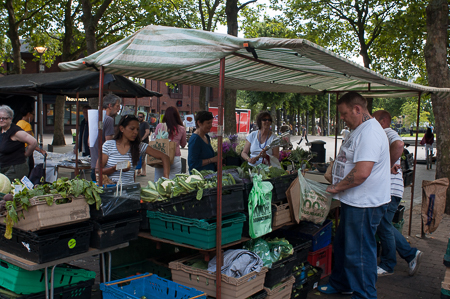
2: veg stall #1

2: veg stall #1

Moving straight in towards the central stall nearest me, I took this. There is a nice array of shoppers’ faces to the left and centre, but not enough of the two stall-keepers and the fact the bigger of the two is nearer the camera means there’s always the likelihood of him blocking his smaller partner. Also, there isn’t much sense of what they’re selling. I could have gone a bit to the right, but instead went left.
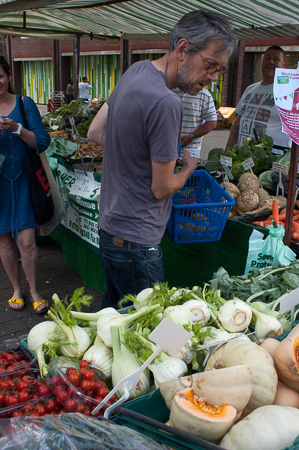
3: veg stall #2

3: veg stall #2

Foregrounded vegetables and almost a nice picture with the shopper making interesting shapes as he reaches for something, while not obscuring the stall-keeper’s expression. And the background is shaded enough to fit the exposure of the people under the awning. So – not bad but, annoyingly, a leaflet pinned to stall’s upright almost does obscure the stall-keeper, and the woman with the blue dress and yellow shoes is neither there nor not there. A bit closer and more angled down from slightly to the left would have cleared the shopkeeper more and removed the woman from the frame. However, it was a fluid moment and didn’t come together like this again.
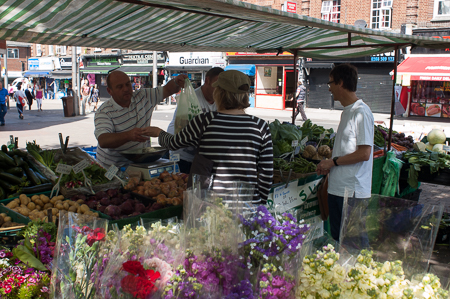
4: veg stand #3

4: veg stand #3

I skirted round the back of the stand to the other side, getting more of an idea of the produce offered but moving me too far away from the action and interposing the rather annoying and soft flowers in the foreground. The two shoppers and the stall-keepers almost make a nice diamond/square, and the timing of passing over both goods and money almost comes off, but a half step to my left would have been better.

Also, the background (the north side of the High Street) is obviously much, much more strongly lit than the stalls. #3 is definitely better, I think. I took one more shot from the same angle, moving from landscape to portrait (5) but it is no better (though might work cropped square).

6 - phone man #1

6 – phone man #1

I’d been clocked by the people at the stall, and rather than get involved in some form of interaction with them, I turned away to my right and saw this where the man on the phone in the centre and the V-shape of the two angle produce racks caught my eye.

7: phone man #2

7: phone man #2

I pressed on and took 7…

8: phone man #3

8: phone man #3

…moved in closer and – having been spotted and being unable to read whether my taking pictures was viewed as good, bad or neutral because of the man’s sunglasses…

9: phone man #4

9: phone man #4

…I pulled back again. The closer shot with him looking into the lens (8) works best, I think with the awning and the stall forming a rough oval around him.
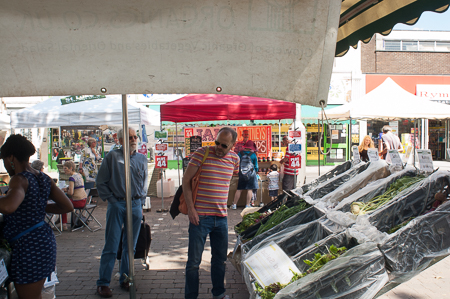
10: phone man #5

10: phone man #5

The man finished his call and began to move away; I moved closer again and quite like the abstract planes of the over-exposed background, the array of veg and the flatness of the awning in the top left and centre, framing the three people in the bottom left of the frame. If the aluminium pole wasn’t hiding the bearded man, and the woman wasn’t leaning out of the left of the frame, it might be quite a nice picture. Half a step left?

No! – I had already noticed the jam and chutney stall in the background, and had moved off to the right and gone around the stall to get closer. If the aluminium pole wasn’t hiding the bearded man, and the woman wasn’t leaning out of the left of the frame, it might be quite a nice picture. Half a step left? No! – I had already noticed the jam and chutney stall in the background, and had moved off to the right and gone around the stall to get closer.

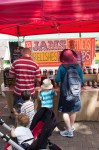
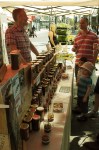
11: chutney #1

11: chutney #1

I took this. It’s got good clean edges and the various planes as you move away from the camera are broken enough by the numerous rectangles formed by awnings, signs and other stuff to let your eye settle on the grounp of people – 2 adults, two children and the stall-keeper – with the interaction between the keeper and the boy on the right centring the group and giving the picture obvious narrative possibility. But other than squares and rectangles, there’s nothing going on in the left half of the picture. I stepped in and round…

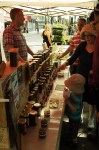
…and someone pushed a pushchair in from the left of the frame. I tried to compensate and 16 almost works, but the hand coming in from the left holding the pushchair distracts from everyone else’s focus on the central area of the frame.

16: chutney #5

15: chutney #5

I stepped back. Again this works, I think, with the slightly off centre grouping of red or crimson people and objects surrounded by blues and whites is quite pleasing, and would probably become more so with a slight crop to remove some of the seated people to the left and to move the main stall more off centre. I stepped back in closer, and it all fell to pieces somewhat (16).

And then – 17-20 – I moved round to the side to try and get something of everyone’s faces; it sort of worked but there was a gulf between the stall-keeper and the shoppers if the picture was portrait (although I quite like the jam-bottles) and when I tried landscape – 21 – it’s a bit better, but not lots better. Tilting down a bit might have helped here.

22: chutney #

22: chutney # 12

I went round towards the back of the stall and took this before realising the whole sequence had probably peaked somewhere between 11 and 15. Admitting this, I explained what I was doing to the stall-keeper, took a conventional portrait of the stall-keeper and left….

24: the stall-holder

24: the stall-holder

All in all then, not the best day’s shooting I’ve ever had (If I’d been Garry Winogrand, this would probably have been one of the films that wouldn’t have got developed; and I’m sure Cartier-Bresson had days when only thin boys jumped over unreflective puddles behind the Gare Saint Lazare…). Some of the results – particularly with a couple of slight crops – are ok, I suppose. I don’t think I ever came particularly close to seizing a decisive moment (and the continually changing relationships between numerous people make this harder of course), but possibly with the object of the exercise being to document the moving into position as well as the final “good” composition, that was never going to happen here.

“Good” photography was made harder by the preserve stand’s awning casting a very persistant reddish cast on everything; I’ve included some pictures as shot and some at least partially colour-corrected.

I think it is a good exercise to have done and a better one to have thought about, but the thing I always find nerve-wracking about taking pictures in public places – the spoken or unspoken negotiation that goes on between you and the strangers in your pictures – was made worse by the need to document getting into postion as this removed the ability to get in place and then take one, or two quick shots before moving away. I felt very uncomfortable and – by the time I’d gone to a nearby pub to review what I’d done over a soda and lime – I was quite drained by the experience.
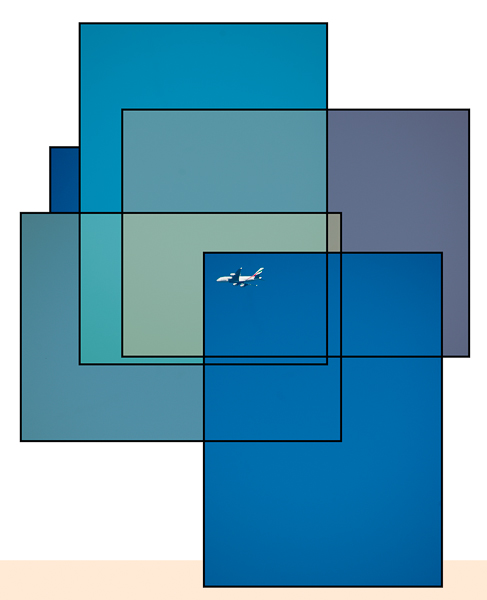
the frame # 2 – object in different positions in the frame

oca-1.2-7This is the exercise where you shoot a subject that is relatively small against a fairly flat background. As Walthamstow is under several flight-paths, it seemed a good idea to  try shooting aeroplanes against a cloudless blue sky. I did this on the same day as I took the ‘movement’ pictures‘ and made the horrible mistake of forgetting that for short exposures, I didn’t need to have the ISO set at its lowest and least sensitive (which was of course needed to be able to take long exposures in bright sunlight). Ah well!

I had with me my Nikon D50 and on it I had a Nikkor AF-G 70-300mm zoom. The intention was to use the zoom at its longest, giving the equivalent of a 450mm lens on a 35mm camera; this meant that I needed to set the shutter speed to at least 1/500th sec to avoid camera shake, leaving me with little option but to have the lens wide open at f5.6. And this, if you look up the lens’ performance on line, means that your pictures will be soft, as zoomed to the max, it needs to be at about f11 before it’s acceptably sharp. this is before you add in the effect of several thousand feet of hazy air. Of course, I could have upped the ISO to 800 and got f11, but I didn’t. Dolt! Idiot! Anyway…

…here’s the results (each individual photos rather than crops of a single picture), in order of (my) preference:

I think the reasons for my ordering them like that are:

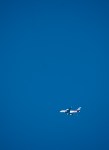
  1. Comfortably in the air, with space to fly into…
  2. A sense of ascent somehow – the angle of the fuselage to the bottom of the frame; the space above?
  3. Descending…
  4. A bit meh, but okay – would – might? – work if tighter, and sharper…
  5. Better if nearer the top of the frame
  6. Uncomfortably close to the edge; on a different day (or a different subject) I might like this…

Most of these seem to be based on the sense of narrative given to the the picture, creating a sense of before and after the moment when he picture was taken. The impact is based on how off-balance the picture is, with the “extremely off balance” version (6) and the “equilibrium” versions (4 & 5) working less well that the off-balance-but-not-too-much ones.

Also, even at 1/500th second, it was fairly hard keeping the camera steady enough for focus – 1/1000 would have been better, so I tried tracking several aircraft before I latched onto this one and managed to get more than a couple of pictures with it in the frame where I wanted it before it decreased dramatically in size as it flew off towards Heathrow.

As a last technical note, it’s worth noting that the underside of an aeroplane will be several stops lower (f4 v f16) using “sunny sixteen” exposure calculation making it very hard to get detail on the bottom of the wings, if you can see the fuselage sides and top, particularly if the plane is painted white…

the frame # 1 – fitting the frame to the subject

panorama from tyre yard set

I intended to use a corner shop with an awning and a display of fruit and veg outside for this, but on my way back from taking the movement pictures by the Lea, I noticed a tyre sales yard by the side of the road with a wild array of signage and – remembering that I’d never managed to take a satisfactory picture of it in the 4 years or so I’ve been passing – thought I’d give it a try.

tyre yard 1

Picture 1: without taking too much time over it…

I quite like this – there’s an organised chaos feel to the site and the markings on the road begin to converge on the entrance (something that could be pointed up a bit by shooting from a higher vantage point, somewhere to the right of where I was standing); the sky is a nice blue (contrasting with the yellow signs and barrier). It works as a record of a place, and you can see how the signs all are focussed on passing trade in cars.

As a bonus it has a sort of American feel, somehow which works with subject matter. Next, I crossed the road to get closer and took the next in the series.

tyre yard 2

Picture 2: more care taken to fill the frame to the edges.

There is a lot more to look at here somehow: the various lines make it difficult for your eye to settle comfortably, and you scan over the image taking in details – the text on the signs, the two stacks of painted TYRES, the railings and the vanishing point off implied off to the right contrasting with the flatness of the hoardings. I had a couple of goes at this, mainly trying to get the right balance between the bollard at the bottom right and the top of the white hoarding. I’m not sure why I didn’t take half a step back to get slightly more room for the bollard, but I didn’t; possibly I was slightly too concerned about filling the frame right to the edges; possibly I didn’t want to step backwards off the pavement into the path of a car…

tyre yard 3

Picture 3: a detail

Next, a detail. I took two closeups of a stack of tyres with ‘tyres’ painted onto it. Which of the two to choose?

The first had more sky in it and some space at the top or the bottom of the stack, but the curve at the top was burnt out in a way that wasn’t pleasant.

This one isn;t overexposed anywhere and has a simple reduced range of colours with grey white and black predominating and the blue outline matching the blue of the sky. Also the repetition with the second stack in the background works with the whole. This, therefore becomes the one to go with.

tyre yard 4

Picture 4: in its environment

Lastly, there was only the wider shot, showing the tyre yard in context. I could have gone a bit wider with this, but I quite like the road and the traffic giving a bit more of a sense of the passing trade the signs are there to alert and also of the drainage channel leading to the reservoirs further up the Lea Valley at the bottom right. The colours are nice again as well.

I made two crops from this one as well: a panoramic cut from the left of the main, yellow sign to the right edge of the frame, emphasising the relationship between the road and the site and between cars and the need for tyres – used as a header for this post – and a square crop of the signs and a bit of contrasting greenery.

It might have been an idea to include more of the road and the traffic in the original, uncropped photograph, as this would have allowed a more balanced panorama, but overall, I am quite happy with the exercise, not disliking any of the pictures.

Panel Discussion: Photography Today – National Portrait Gallery, 05-vi-14

From my photography day-book...

From my photography day-book…

Mark Durden, author of Phaidon’s Photography Today (2014), a survey of photography as art from the 1960s to the present, is joined by the Guardian’s photography writer Sean O’Hagan* and photographer Sarah Jones to discuss themes of the self, the face and the body in photographic works by modern masters such as Diane Arbus, William Eggleston, Nan Goldin and James Nachtwey. In association with Phaidon. Continue reading

a start at reading

Yesterday, two packets from Amazon landed on my desk at work. They contained:

  • The Photographer’s Eye – Michael Freeman (ILEX, 2007)
  • Photography, A Critical Introduction, 4th Edition – ed. Liz Wells (Routledge, 2009)
  • Behind the Image Research In Photography – Anna Fox & Natasha Caruana (AVA Academia, 2012)

After work, I stopped off at The King and Queen for a pint and to have a first look at the new books, having enough time to read the introductions before I went on to the tube and home. Continue reading

getting to know your camera # 5

Photographing Movement 2 – Panning Camera With Subject At A Variety of Shutter Speeds
speeding cylist in the lea valley park

Nikon d50; 24mm lens; 1/15th sec

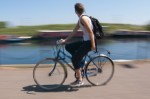
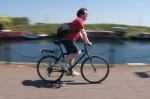
Having completed the static camera exercise with people on foot, I decided to try cyclists for the next one where I was to pan with the moving subject and observe the difference between different shutter speeds. I moved onto a wider lens (a nikkor 24mm 1:2.8 ais) to allow for the faster moving subjects to come into shot, be picked up by me and then followed as they passed through the centre of the shot.

It worked quite nicely, but I was out of the shade and in blazing sun and there weren’t enough passing cyclists. So I crossed the Lea to the tow path of the navigation, settled myself down on a bench and swapped lenses for an even wider Zenitar 16mm 1:2.8, giving a 35mm equivalent of 24mm, as the cyclists would be passing much more closely than before.

(I know that 1/40th of a second (4) is faster than 1/30th (5), but pretending it isn’t preserves alternating directions of movement)

Once again, the strength of the light and the limitations of my camera’s ISO settings meant that much slower than 1/15th sec burnt out too much.

General Observations on the Exercise:
  • Below 1/10th of a second, it is hard to track your camera with a quickly moving object
  • Timing the start of the exposure is critical if you don’t want the subject to approach or depart at an oblique angle
  • Approaching obliquely (3 & 4)  is vastly preferable to departing obliquely (none, for that very reason)
  • The distance between the camera and the moving object decreases as it approaches, reaches a minimum when the object is parallel to the film plane/sensor and then increases again. Therefore the moving object slows down as it nears the centre of the frame and the accelerates away. This means that the further away from the midpoint you open the shutter, the more the rear of the object will move at a different speed from its front. This gives interesting distortion  effects (clearly seen in 4, where – I think – it enhances the sense of speed)
  • The closer to the camera the subject passes the more exaggerated the effect of this.
  • The closer to the camera the greater the relative sense of movement for static objects: the pictures here have three planes – the cyclist; the chain fence by the canal; the far side of the canal with the moored narrow boats – and the furthest loses its enhancing sense of movement first, then the railings, and finally the cyclist. At a 1/100th sec the background is still blurred and streaky; at 1/250th sec the chain is blurred by the background is coming to a halt; at 1/1000th sec all movement is frozen
  • The rim of a wheel is travelling faster than the hub: the later pictures (1/100th onwards) show spoke detail at the centre of the wheels, but blurs at the rim. At 1/1000th everything is static
  • If you manage to keep part of the moving object sharp (here, with cyclists, the face is key I think) the image is a good one (see 3, for a successful sense of movement with my pan remaining steady on the cyclist)

Different parts of the image all combine to create a sense of movement. Everything does not have to be blurred (and indeed something frozen is definitely required). The differing levels of blur are created by distance, relative speed and steadiness of pan. As with the previous exercise, some experimentation is probably required to establish the correct combination of these for the effect you want.

getting to know your camera # 4

Photographing Movement – Stationary Camera With A Variety of Shutter Speeds

man on a velocipede

Nikkor 1/1.8:50 AF-D; f22; 1/8th sec

Joggers, cyclists and dog walkers are found in abundance in the parkland that stretches down the Lea Valley from Tottenham Hale to the Lea Bridge Road. It seemed a good choice for the exercises featuring movement at varying shutter speeds. For the series taken with a fixed camera, I set up a Nikon D50 low on a tripod, pointing up the long stroke of a T-junction. The camera was triggered using an infrared remote. I used a 50mm lens, capable of stopping down to f22 as this would give me the widest possible range of slow speeds on what was a very bright day to be using a camera with a lowest ISO of 200. The resulting shots cover a range from 1/8th of a second to 1/400th of a second.

1/8th sec – runner
runner 1/8th sec

Nikkor 1/1.8:50 AF-D; f22; 1/8th sec

Almost melts into the air, leaving an elongated series of brushstroke-like traces as he goes. good for a highly abstracted sense of movement. His grounded foot remains stationary for the time the shutter is open (and will only begin to move as his trailing leg moves past it and the heel starts to rise) meaning that the Nike swoosh on his running shoe is the only fully identifiable part of him.

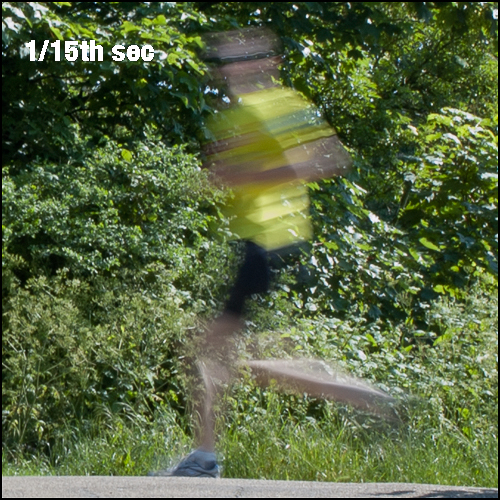
1/15th sec – runner
runner 1/15th sec

Nikkor 1/1.8:50 AF-D; f22; 1/15th sec

A more identifiably human presence – you can tell that a man in a yellow top and black shorts, wearing sunglasses has looked to his left as he passes the camera. He has been caught at a different point in his stride from the previous shot and his grounded foot has started to move although his trailing leg is less elongated. Against a more neutral background I think this would work nicely.

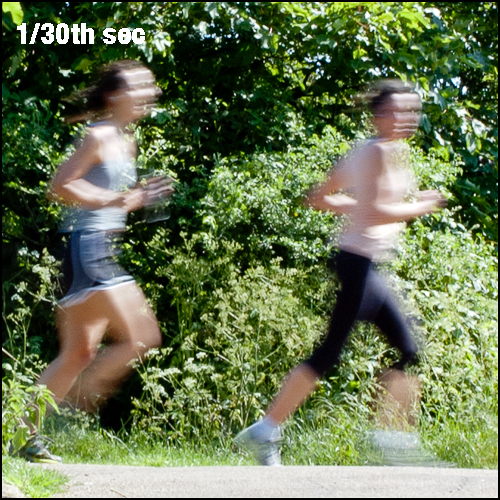
1/30th sec – Runners
runners - 1/30th sec

Nikkor 1/1.8:50 AF-D; f22; 1/30th sec

Neither figure is as pleasingly caught and blurred as in the previous shot, but the leading woman is the better of the two as she is further from the point where the two legs and arms cross the body rather than stretching out in front and behind. Gauging a shutter speed appropriate for the speed of movement is important, but so is timing relative to the stage of the action photographed.

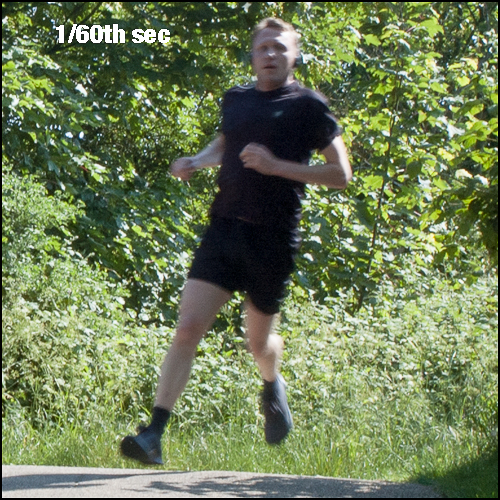
1/60th sec – runner
runner 1/60th sec

Nikkor 1/1.8:50 AF-D; f22; 1/60th sec

He is crossing into the frame around the corner, rather than parallel to the plane of the sensor and so his relative movement is therefore less, and the effect is simply that he is out of focus. This creates a slightly troubling effect given that there are objects both behind him and between him and the camera that are firmly in focus. Given that his feet are both off the ground, this particular shot might have worked better with a much shorter exposure leaving him hanging frozen in mid air…

1/125th sec – walker
woman walking, 1/250th sec

Nikkor 1/1.8:50 AF-D; f22; 1/250th sec

She is moving more slowly than he is but like the runner above she is simply a bit soft within a sharp frame. Presumably she has covered a similar distance relative to the camera plane. The timing of the exposure relative to her movement is nice however – she is obviously mid stride.

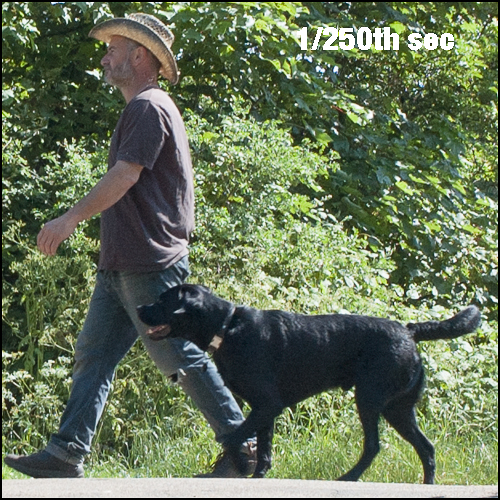
1/250th sec – walker with dog
walking man and dog 1/250th sec

Nikkor 1/1.8:50 AF-D; f22; 1/250th sec

Pretty much frozen, apart from the dog’s front-left paw. Not bad.

1/400th sec – walker with dog
man and dog walking, 1/400th sec

Nikkor 1/1.8:50 AF-D; f22; 1/400th sec

Frozen, but not as nicely timed as the previous shot; the man’s okay but the dog’s legs are a bit of a mess in timing terms.

Conclusions

Different speeds of movement will require different exposure times to get the desired effect. Similarly, different directions of travel relative to the camera will effect the impression of movement. Timing the shot relative to the stage the subject’s movement has reached is also important. There is an area between extreme motion blur and frozen that is less successful than either extreme, for movement involving legs at any rate. In every new situation, you will probably need to experiment a bit before you determine where the sweet spots are, based on time, direction of movement and the desired effect. I suspect it would be good to revisit Muybridge’s work

The last 3 pictures feature a couple and their labrador who wondered what I was doing and then – after I explained – offered to do the last few passes, saving me some time waiting for someone to turn up naturally. Thank you, anonymous couple – I realise I should probably have got their names, and let them know somewhere where they would be able to see the pictures, like here!

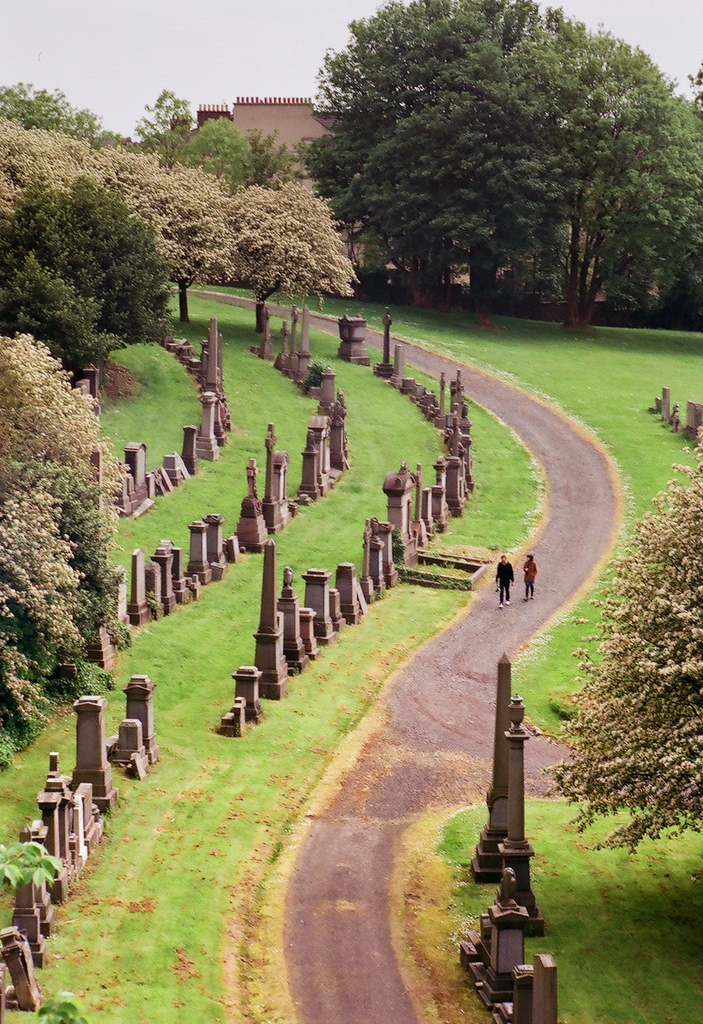
a couple of hours in the necropolis

looking east from the necropolis, glasgow

Pentax Spotmatic F. Jupiter 9 1:2/85 1/250th sec @ f11. Fuji Superia 400 asa

(Notes on my shoot for the fourth exercise in part 1 – using different focal length lenses from a fixed position)

This weekend I had a couple of totally free hours that I filled by going to the Necropolis for the first time in around 30 years. Back then it was all fairly dilapidated – I think you weren’t even meant to go in in case a vault collapsed under you – but now it’s been cleaned up, made sound and become part of the tourist experience.
As I spend a fair amount of time in Glasgow, I keep a Pentax Spotmatic-F and a set of lenses there to cut down on the amount of luggage I need to take with me when I travel up from London. Glasgow is also where I get film developed, at the Snappy Snaps on Byres Road, so if I finished the film I already had in the camera, there wouldn’t be a delay in viewing the results.

The Necroposlis sits on a steep hill separated from the cathedral by a steep valley and if you look back as you follow the twisty path up towards the monument to John Knox, there is a fine view west. I realised that this was probably as good a place as any to work through lenses with a variety of lenses:

  • Super-Takumar 1:3.5/28
  • Super-Multi-Coated Takumar 1:2/35
  • Super Takumar 1:1.4/50
  • Jupiter 9 1:2/85
  • Super Takumar 1:3.5/135 (2 shots, the second with a x2 teleconverter)

The camera was on a tripod, but some adjustment was made for composition as the frame tightened. All exposures, 1/250th second at f11. Film used 400 asa Fuji Superia.

The picture at the top of this post was taken later, on the other side of the hill looking east. It may form part of Assignment 1.

getting to know your camera # 3 – focus at different apertures

oca-0.3-3

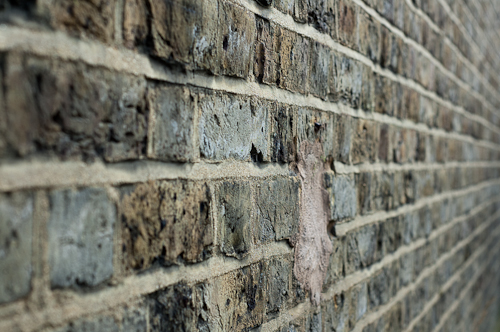
All three photographs were taken with a Nikkor 50mm 1:1.8 AF-D lens on my Nikon D50. Focal length equivalent of around 75mm on a full frame camera. ISO was set to 200. Shutter speed varied according to the aperture.

oca-0.3-1

f1.8: A very narrow depth of field; almost everything except for a narrow band down the centre of the image is out of focus; moving out from the focussed strip the quickly becomes very blurred indeed.

oca-0.3-2

f6.3: A wider area of brick is in focus, stretching with a greater increase to the right of the image, where the wall was further away from the camera. The entire image is now readable as brick.

oca-0.3-4

f22: The strip widens again, and – unless you look closely – most of the picture seems clear, if not completely sharp. This time the increase seemed evenly spread on either side of the original in-focus area, which suggests maybe I knocked the point of focus off to the right when I was changing the aperture.

Nothing to add to this really; the smaller the aperture the greater the depth of field. It’s always interesting to do exercises like this and see in practice what the theory says…